I have moved house six times. I have therefore packed and unpacked my belongings six times, and each time I have arrived at some object — a mug I don't especially like, a book I bought on holiday and never finished, a small ceramic figure of a cat that I cannot identify the origin of — and had to decide whether to keep it or let it go. And each time, something about the decision has felt unreasonably significant. Not because any of these objects are valuable. Because each of them has somehow become, incrementally and without my consent, a small piece of my sense of self. Throwing away the mug felt like erasing something. I still have the mug. I still don't like it.
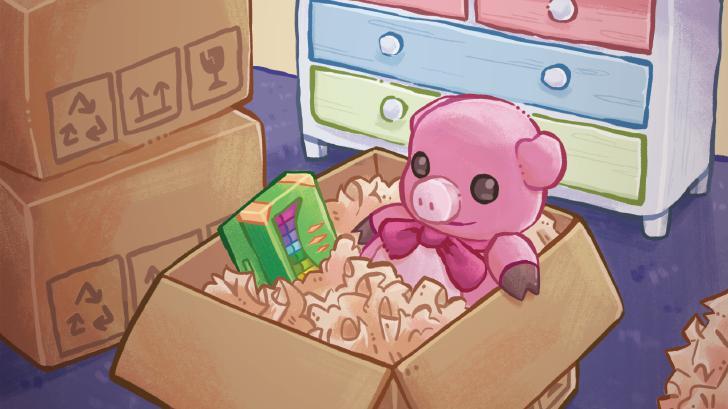
Unpacking, the puzzle game from Witch Beam, is entirely about this feeling. You receive boxes. You place objects in rooms. There is no character to look at, no dialogue to read, no explicit story. And yet, about twenty minutes in, I was experiencing something that felt uncomfortably close to biography — watching someone I'd never met live their life through the objects they carried from one home to the next. The stuffed pig that survived every move. The university certificates that didn't make it past a certain chapter. The first time a second person's belongings appeared in the bedroom and had to be made room for. None of this is told. All of it is shown, entirely through stuff.
Russell Belk wrote the definitive paper on why this works in 1988. He called it the extended self, and it is one of those theories that, once you encounter it, you cannot look at a mug the same way again.
The Game
Unpacking was developed by Witch Beam and released in 2021. The mechanic is genuinely simple: you open boxes, you take out objects, you place them in the room in a way that makes spatial sense. Objects have preferred locations and the game will gently indicate if you've put something somewhere odd — a diploma in the bathroom, say. Eight levels span the protagonist's life from childhood bedroom to settled adulthood, each one a new house and a new configuration of the same collection of possessions, slowly growing and changing. It won a BAFTA for Game Design. The ASMR-adjacent sound design — the soft thud of a book on a shelf, the clink of a mug on a countertop — is almost criminally relaxing.
The design decision that elevates it from puzzle game to something more interesting is the absence of explicit narration. The game trusts that objects carry sufficient meaning to tell a story without words. And they do — more than you might expect, and more than is entirely comfortable once you start paying attention to what your own possessions might be saying about you.
Possessions as Self — The Research
Russell Belk's 1988 paper, "Possessions and the Extended Self," published in the Journal of Consumer Research, proposed something that sounds slightly strange until you think about it for thirty seconds and then cannot stop thinking about it: that people's sense of self extends beyond their bodies to encompass their possessions, their relationships, and the places they inhabit. We don't just own things. We incorporate them into our identity — we use them to create, maintain, signal, and experience who we are. The loss of a possession is not merely an inconvenience; it can feel like a loss of self, because in a functional sense it is one.
Belk drew on a wide range of evidence: developmental psychology (children begin asserting "mine" before they can fully understand ownership, suggesting that self-extension through possession is a very early cognitive move); anthropology (the universal practice of burying possessions with the dead, as though the self extends into objects sufficiently that separating them at death is unseemly); consumer behaviour (the disproportionate distress people experience at the loss of irreplaceable objects compared to replaceable ones, even when the replaceable object is more financially valuable). The argument is not that people are materialistic in a pejorative sense. It's that possession and identity are structurally linked in ways that are deep, developmental, and probably adaptive.
The extension of this that is most relevant to Unpacking is the idea that different kinds of possessions serve different identity functions. Some objects are expressive — they signal who you are to others, or to yourself. Some are connective — they link you to other people, to places, to periods of your life. Some are constitutive — they feel like they are you, not just represent you. The stuffed pig that the character in Unpacking carries from childhood into every subsequent home is not decorative. It is constitutive. Its presence in a room tells you something about the person that no amount of furniture arrangement could communicate.
The Room as Biography
What Unpacking does with Belk's framework is make visible the curatorial work we do with our possessions constantly and largely unconsciously. Every time you move, you make choices: what comes with you, what stays, what gets put in the back of a cupboard versus the front of a shelf. These choices are identity decisions, even when they don't feel like it. The book you display prominently is a different statement from the book you keep but hide. The award on the wall means something different from the award in the drawer. The game externalises this process and slows it down enough to see it, and what you see is that a life can be read in the accumulation and arrangement of objects if you know how to look.
There is one level in particular — which I will describe only vaguely to avoid spoiling it — where the protagonist's possessions do not fit comfortably into the available space. Not because there are too many objects, but because the objects don't match the room. You, the player, are physically enacting the experience of trying to fit your life into a context that wasn't designed for it. It is one of the more effective uses of game mechanics as emotional metaphor I have encountered, and it works entirely because Belk's logic is operating underneath it: these objects are not just objects, they are the character, and when they don't fit, the character doesn't fit.
Is there an object you own that you'd find genuinely distressing to lose — not for its financial value, but for what it means?
What To Do With This
The extended self framework suggests that decluttering — the great contemporary obsession, the entire genre of television shows and books about letting things go — is psychologically more complicated than it looks. When Marie Kondo asks whether an object sparks joy, she is essentially asking a version of Belk's question: is this still part of your extended self, or has it become a relic of a previous self that you're carrying forward out of habit? The objects that cause the most difficulty to let go are often not the ones we like most. They're the ones that are most deeply incorporated into our sense of who we are or who we were — and releasing them requires something more than a decision about space.
The flip side of this is that surrounding yourself with objects that reflect who you actually are — rather than who you thought you were, or who you were performing being — turns out to matter. Studies in environmental psychology have consistently found that personalising one's space improves wellbeing, sense of control, and belonging. The student who puts up their own pictures in a university room reports higher satisfaction with the experience than the one who doesn't, even controlling for room quality. You are, to a meaningful degree, made of your stuff. It's worth being thoughtful about which stuff.
The takeaway: Russell Belk's 1988 extended self theory proposes that people incorporate possessions into their identity — using them to create, maintain, and communicate who they are. Losing an object can therefore feel like losing a piece of self, and carrying objects across life transitions is often a way of maintaining continuity of identity. Unpacking makes this visible without a word of dialogue, through the simple act of watching what a person keeps, and where they choose to put it.
Play It When You're About to Move
Unpacking is about two to three hours long, it is very inexpensive, and it is available on everything including mobile. It is also extremely good to play either just before or just after moving house, because it will give you a framework for thinking about what you're doing that makes the experience feel less like hauling boxes and more like a ritual of self-definition. Which it is. That mug you're about to decide whether to keep — it means something. You don't have to know what, to acknowledge that it does. And if you can't explain why you're keeping it and you can't explain why you don't want to get rid of it, that's probably Belk's answer right there.
No comments yet — be the first!