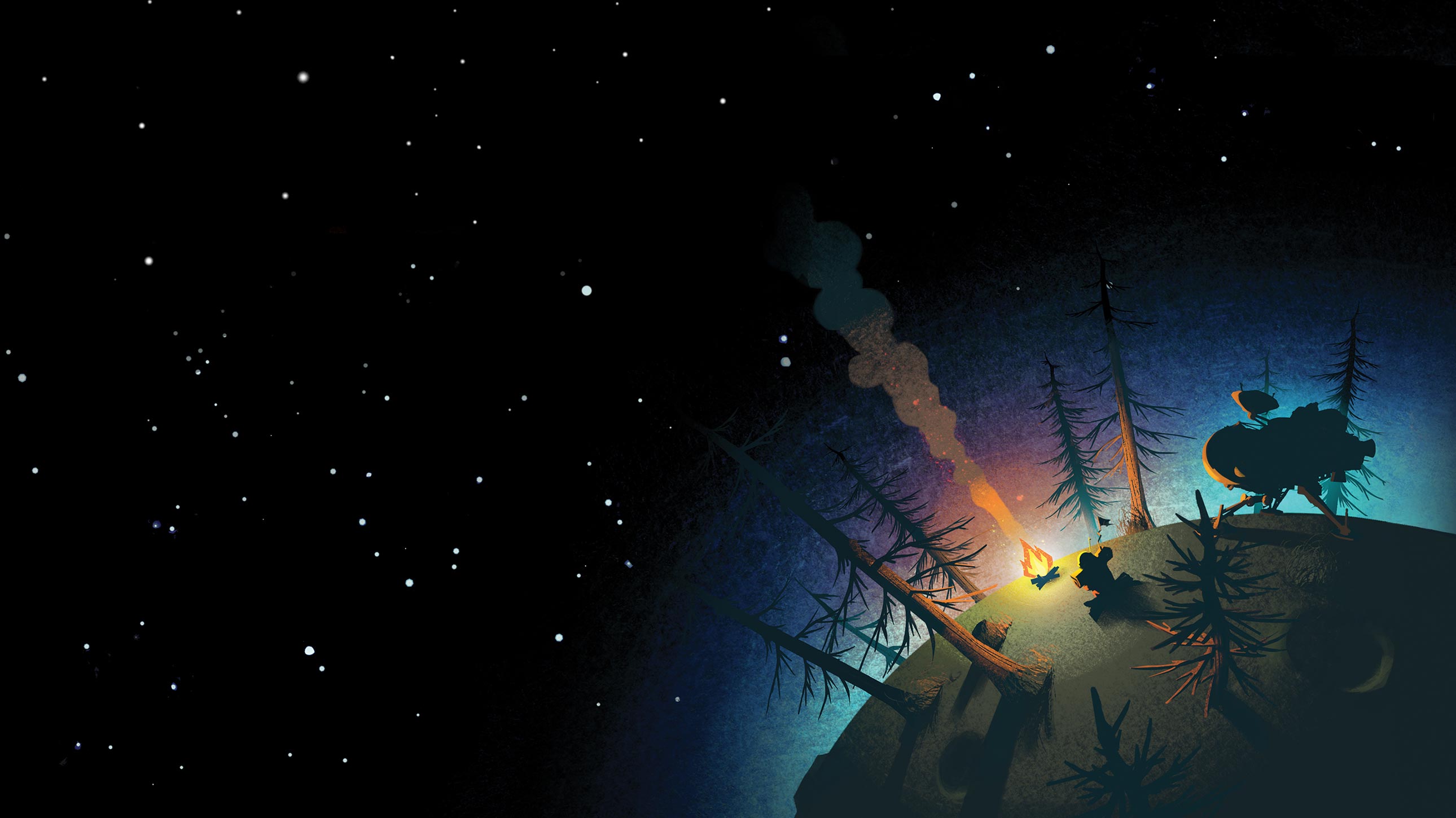
There is a moment in Outer Wilds — I will describe it without spoiling anything, which is a constraint the game requires and the game deserves — where you find a piece of writing on a wall that ends mid-sentence. Not because the writer died, or the page ended, or the game ran out of room. It ends mid-sentence because the sand came in while the writer was still writing, and whatever they were about to say is now buried somewhere below you, and you have to decide whether you care enough to find out what it was. I stared at that half-sentence for a long time. Reader, I cared. I spent forty-five minutes finding out what it was, which involved dying seven times and accidentally falling into a sun once, and when I finally read the rest of the sentence I made a sound that my flatmate later described as "concerning."
The game does this to you constantly. It is constructed, almost entirely, from half-sentences — fragments of information that are just complete enough to tell you that there is more, and just incomplete enough to make not knowing feel physically uncomfortable. There is no quest marker. There is no map legend. There is just the universe, and the knowledge that it contains answers, and the certainty that you don't have them yet. You will not be able to think about anything else until you do. This is not an accident.
George Loewenstein wrote a paper in 1994 that describes exactly what Outer Wilds is doing to you. He called it the information-gap theory of curiosity, and it is one of the more useful frameworks I have encountered for understanding why I have twice missed a train because I needed to know one more thing before I left the house.
The Game
Outer Wilds was developed by Mobius Digital and released in 2019, after a lengthy development that began as a Masters thesis project at the University of Southern California. You play as a young Hearthian — a small, curious species of alien — on your first solo trip into space. The solar system is tiny and explorable: six planets, a comet, a few moons, each with their own physics, their own secrets, their own ancient ruins left by a vanished civilisation called the Nomai. And then, twenty-two minutes after you launch, the sun explodes and you wake up at the start of the day again, in a time loop, with everything you've learned but everything reset. The game's central puzzle is not a dungeon or a boss. It is the question of why any of this is happening, and what you're supposed to do about it.
The design choice that makes it extraordinary is the decision to give the player no objective markers, no quest log, no hint system. Every piece of information is physical, located in the world, legible only through exploration. The game can only be completed once you understand it — and understanding it requires finding things in an order that is entirely up to you. This means that every player's experience is shaped by which question they happened to be curious about first, and where that question led them. The game is a different shape in different heads, but the curiosity — that consuming, slightly torturous need to close the gap — is universal.
The Gap — The Research
George Loewenstein's 1994 paper, "The Psychology of Curiosity: A Review and Reinterpretation," is both a literature review and a theoretical intervention. Earlier models of curiosity had treated it primarily as a positive drive — you see something interesting, you want to explore it. Loewenstein's reframing was more precise and, I think, more honest: curiosity is aversive. It is not primarily the pleasure of finding out; it is the discomfort of not knowing, once you've become aware that there is something to know. The gap between what you have and what you want is the source of the motivation, and it functions like an itch — something you are driven to relieve rather than something you actively enjoy experiencing.
The practical implication is that curiosity is not triggered simply by encountering an interesting subject. It's triggered by becoming aware of a specific gap in your knowledge. Loewenstein drew on research showing that curiosity about a question increases when people know something about the answer — not when they know nothing. Complete ignorance produces no curiosity, because there is no gap to feel. Complete knowledge produces no curiosity, because the gap is closed. The peak curiosity state is partial knowledge: knowing enough to know what you don't know, and feeling the incompleteness of that as a genuine motivational force.
This is sometimes called the "region of sensitivity" — the zone of partial information where the gap is perceptible but not yet filled. Trivia games exploit it expertly: the moment before you're told the answer to a question you almost know is more engaging than the answer itself. Documentary filmmakers use it as a structural principle: introduce the question early, withhold the answer, let the gap do the work. And Outer Wilds uses it as its entire game design philosophy — every room is a breadcrumb, every breadcrumb points to a gap, and the gap is the engine that keeps you moving through a solar system that keeps exploding around you.
What the Nomai Knew
The Nomai — the ancient civilisation whose ruins you're exploring — were, canonically, intensely curious. Their architecture is covered in recorded arguments and dialogues, in debates about what they'd found and what it might mean, in half-finished theories left for future visitors to read. Encountering their notes is itself a curiosity experience: each one tells you something and implies ten more things, and by the time you've read a dozen of them you are, without entirely meaning to, invested in people who have been dead for hundreds of thousands of years. The game understands that curiosity is inherently social — we are most powerfully curious about what other minds know, have known, or were in the process of figuring out when something went wrong. The half-sentence on the wall is not just an information gap. It is a person, mid-thought, interrupted. That is an almost irresistible thing to want to complete.
Loewenstein's framework also addresses why curiosity can become uncomfortable or even painful. Once the gap is established, not closing it feels bad — and the closer you get to closure, the worse the remaining distance feels. This is why the final hour of Outer Wilds is the most emotionally intense: you can see the shape of the answer, you know you're close, and every remaining gap feels urgent in a way the earlier ones didn't. The itch, at this stage, is not pleasant. It is also completely impossible to stop scratching.
What tends to trigger your most consuming curiosity?
What To Do With This
The information-gap framework is useful in two directions. If you want to sustain your own curiosity — about a subject, a project, a relationship — the key is maintaining an awareness of the gap rather than rushing to close it. Curiosity is highest when you know enough to know what you don't know. Staying in that zone, holding the question open a little longer than feels comfortable, is often where the most productive engagement happens. The researchers, writers, and learners who remain motivated over long periods tend to be the ones who are skilled at finding new gaps as old ones close — who can finish one chapter and immediately identify what the next question is.
If you want to trigger curiosity in someone else — in a student, a reader, an audience — Loewenstein's model suggests that information dumps are the wrong move. Don't explain everything upfront. Give people enough to know that there is a gap, then step back and let the gap do the work. This is what good teachers do, what good writers do, and what Outer Wilds does to you at roughly minute three, when you find a note that mentions something called the Eye of the Universe and offers absolutely no further information about it whatsoever. Thirty hours later you are still thinking about it. That's the gap. That's the whole game.
The takeaway: George Loewenstein's 1994 information-gap theory proposes that curiosity is an aversive state — the discomfort of a perceived gap between what you know and what you want to know — rather than a simple positive drive. It is triggered by partial knowledge, peaks when you can see the shape of what you're missing, and is most intense in the final stretch before closure. Outer Wilds is an eighteen-hour interactive demonstration of this theory, and it is one of the best games ever made.
A Final Note on Spoilers
Outer Wilds is a game that can only be experienced once in its intended form, which is to say: in complete ignorance of what you're about to find. If you haven't played it, please do not look anything up. Not a review, not a wiki, not a YouTube video. The half-sentences on the walls are yours to complete. The itch is the point. Go in knowing nothing, and the game will do the rest — loudly, and in ways that will follow you around for days after you finish, in the very best possible sense of following you around.
No comments yet — be the first!