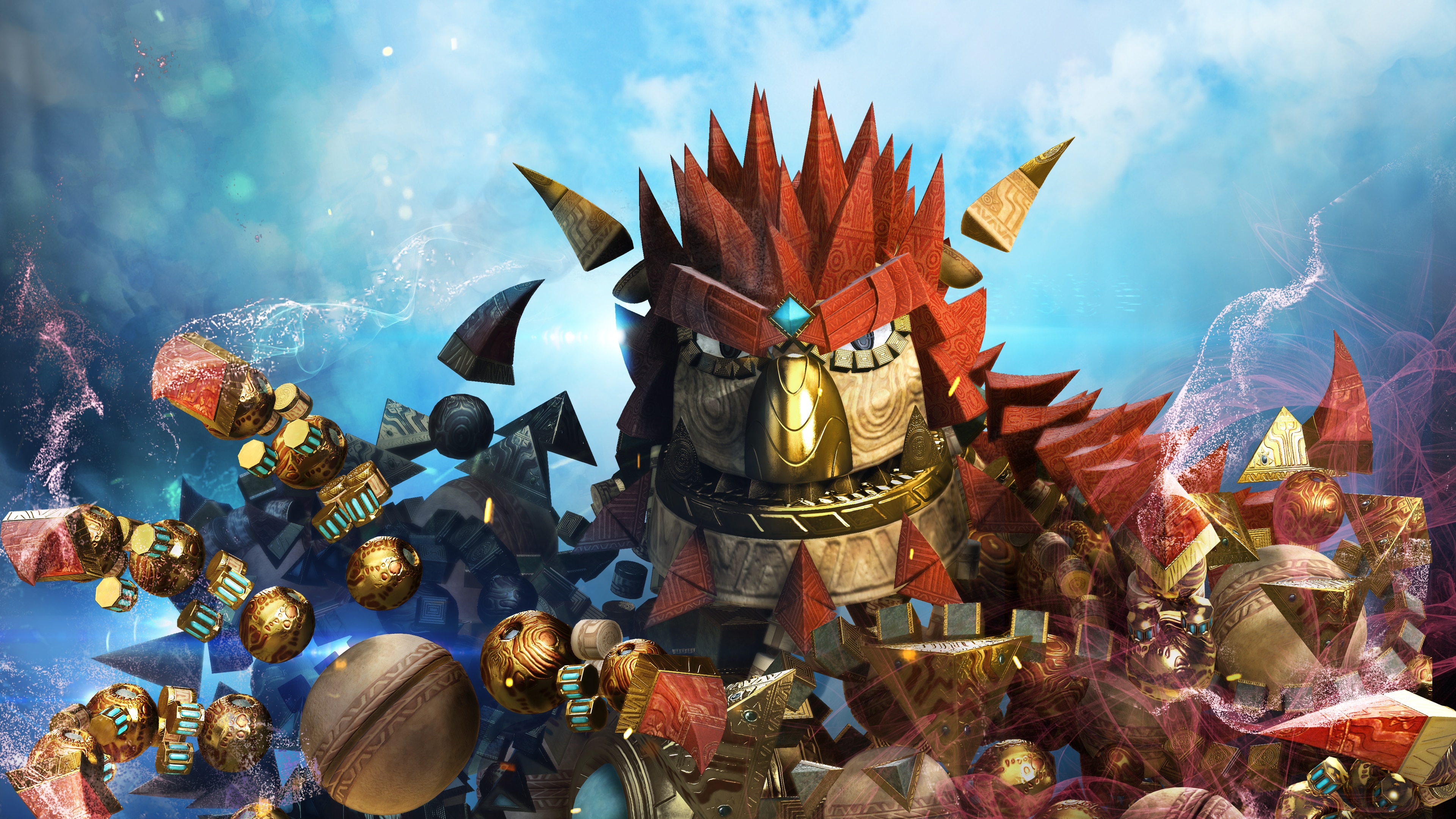
I want to say something in defence of Knack, and I want to say it before you close this tab.
Yes, it was a PS4 launch title. Yes, the reviews were lukewarm at best, and yes, "lukewarm" is doing a lot of diplomatic work in that sentence. Yes, there is a running joke that exists specifically at its expense — some corner of the internet has decided that Knack is the canonical example of a game that exists and not much else.
I played it anyway. I played it because my nephew wanted to, and I was the adult in the room who theoretically knew how games worked, and somewhere around the third hour I stopped being polite about it and started genuinely paying attention. Not to the combat — the combat is fine, adequate, unremarkable. To the mechanic. To what Knack actually does.
Because what Knack does is absorb things. And become something new. And that, it turns out, is worth talking about.
The Game
Knack was released in 2013 as a PS4 launch title, developed by Japan Studio and directed by Mark Cerny — the same man who designed the PS4 hardware itself. The premise involves ancient relics, a war between humans and goblins, and a strange being called Knack who is assembled from said relics and now has to save everyone. Standard stuff.
The mechanic that makes Knack interesting — and that the game never quite makes enough of, which is perhaps why the reviews landed where they did — is that Knack grows by absorbing relics from the environment. At his smallest, he is compact and precise, small enough to squeeze through gaps and navigate tight spaces. As he collects relics, he expands — becomes massive, powerful, nearly unstoppable. But he can also lose pieces. Take enough hits and the relics scatter, and Knack shrinks back down. Sometimes dramatically. Sometimes, in a boss fight, in a way that produces a very specific kind of despair.
The identity shifts as the size does. A small Knack and a large Knack are functionally different characters — different reach, different weight, different relationship to the world around him. What he has absorbed determines who he currently is. And what he keeps absorbing keeps changing that.
I found this oddly moving. My nephew found it fun. We were both right.
Identity Integration — The Research
In developmental psychology, there is a concept called identity integration — the process by which a person takes the disparate pieces of their experience, their roles, their influences, and constructs from them a coherent sense of self. The term has roots in Erik Erikson's work on identity formation in the 1950s, but it has been substantially developed since, particularly by researchers studying how people navigate major life transitions — new jobs, new relationships, significant loss, cultural displacement.
The central finding is deceptively simple: integration matters more than the pieces themselves. Two people can have broadly similar experiences and end up with completely different self-concepts, depending on whether they have actively worked to incorporate those experiences into their identity or simply accumulated them like boxes in a spare room — present, but not dealt with.
Psychologist Dan McAdams, whose research at Northwestern University focused on the narrative self — the idea that identity is essentially the story we tell about ourselves — found that psychological wellbeing correlates strongly not with what has happened to a person, but with how they have made sense of it. The coherence of the story matters. Whether the pieces fit together into something that makes sense to the person living it matters.
This is exactly what Knack is doing, visually, every moment of the game. He doesn't just collect relics — he incorporates them. They become part of him. They change his shape, his capability, his presence. And when they're lost, he doesn't cease to exist. He's just temporarily a different version of himself, working with what remains.
The Relics You Don't Choose
Here is the part of the metaphor that I think is most useful, and that the game doesn't explicitly acknowledge but earns anyway.
Knack doesn't get to pick which relics come his way. The environment determines what's available. He can choose to absorb them or not — but the pool he's drawing from isn't his design. He works with what the world offers.
Most of the things that shape us work the same way. The family you grew up in. The country you landed in. The first people who were kind to you, and the first people who weren't. The job that fell through. The illness that didn't. The friendship that ended in a way you didn't expect and still think about. None of it was selected from a catalogue. It arrived, and then you had to decide — consciously or not — what to do with it.
Research on post-traumatic growth — a field that has expanded considerably since Tedeschi and Calhoun's foundational work in the 1990s — consistently finds that the people who come through difficulty with their sense of self intact, or expanded, are not the ones who avoided absorbing the difficult experience. They're the ones who absorbed it and found a way to integrate it. Who let it change their shape without deciding that the new shape was broken.
Knack, at his smallest, is not less than Knack. He is Knack, working with fewer relics, in a more constrained form, until more becomes available. Some of the game's more interesting design moments happen in the small form — gaps accessible only to a compact Knack that the enormous version could never navigate. The constraint creates capability. The reduction opens a path.
I have definitely been a small Knack. I suspect most people have. It isn't ideal. But it isn't the end of the game.
The Selective Absorption Problem
There's a wrinkle in all of this, and I'd be doing the research a disservice to skip it.
Not everything should be absorbed. Knack doesn't absorb goblin soldiers — they're obstacles, not resources. The game makes a distinction, implicitly, between what builds you and what damages you. Take enough hits from the wrong source and you don't grow — you shrink.
Identity integration research makes the same distinction. Incorporating experiences into your self-concept doesn't mean accepting every external judgment about who you are. It doesn't mean letting every criticism restructure your sense of self. There's a difference between absorbing a difficult experience — grief, failure, a challenging relationship — and absorbing someone else's narrative about your worth.
Psychologist Carol Dweck's work on mindset touches this directly: people with a growth mindset integrate the information in feedback (what can I do differently?) without integrating the identity judgment it sometimes carries (therefore I am inadequate). The relic is useful. The hit is not. Knowing the difference is, unfortunately, one of the harder skills available to humans — and not one Knack has to think too hard about, because the game codes it clearly in colour.
Real life is less colour-coded. Which is annoying.
When something difficult happens to you, what do you tend to do with it?
The takeaway: Identity isn't fixed and it isn't found — it's constructed, continuously, from what you absorb and how you integrate it. The size you are right now is not the size you will always be. The relics keep coming.
In Defence of Knack (And Yourself)
Here is what I want to say in defence of Knack, the game, having said all of that.
It got dismissed because it wasn't spectacular. The reviews wanted something that demonstrated what the new hardware could do in unmistakable terms — something loud and extraordinary. Knack was quiet. It had one interesting mechanic and didn't shout about it. It was, in many ways, a launch title about becoming: a small thing, just starting out, absorbing what it could from its environment, not yet the thing it might eventually be.
I find it hard to dismiss that story now.
You are, at this exact moment, a specific configuration of everything you have absorbed so far. Some of those pieces were chosen deliberately. Most of them arrived uninvited. Some of them changed your shape in ways you didn't want and wouldn't have requested. And yet here you are — a particular, specific, unrepeatable arrangement of all of it. Still absorbing. Still adjusting. Still figuring out what the current configuration can do that the previous one couldn't.
Knack got a sequel, by the way. Knack 2 came out in 2017 and is, by most accounts, genuinely good. The mechanics were refined. The character had grown. What didn't work the first time had been reworked. The reviews were kinder.
Turns out the sequel is always better when you've absorbed enough to know what you're doing.
No comments yet — be the first!