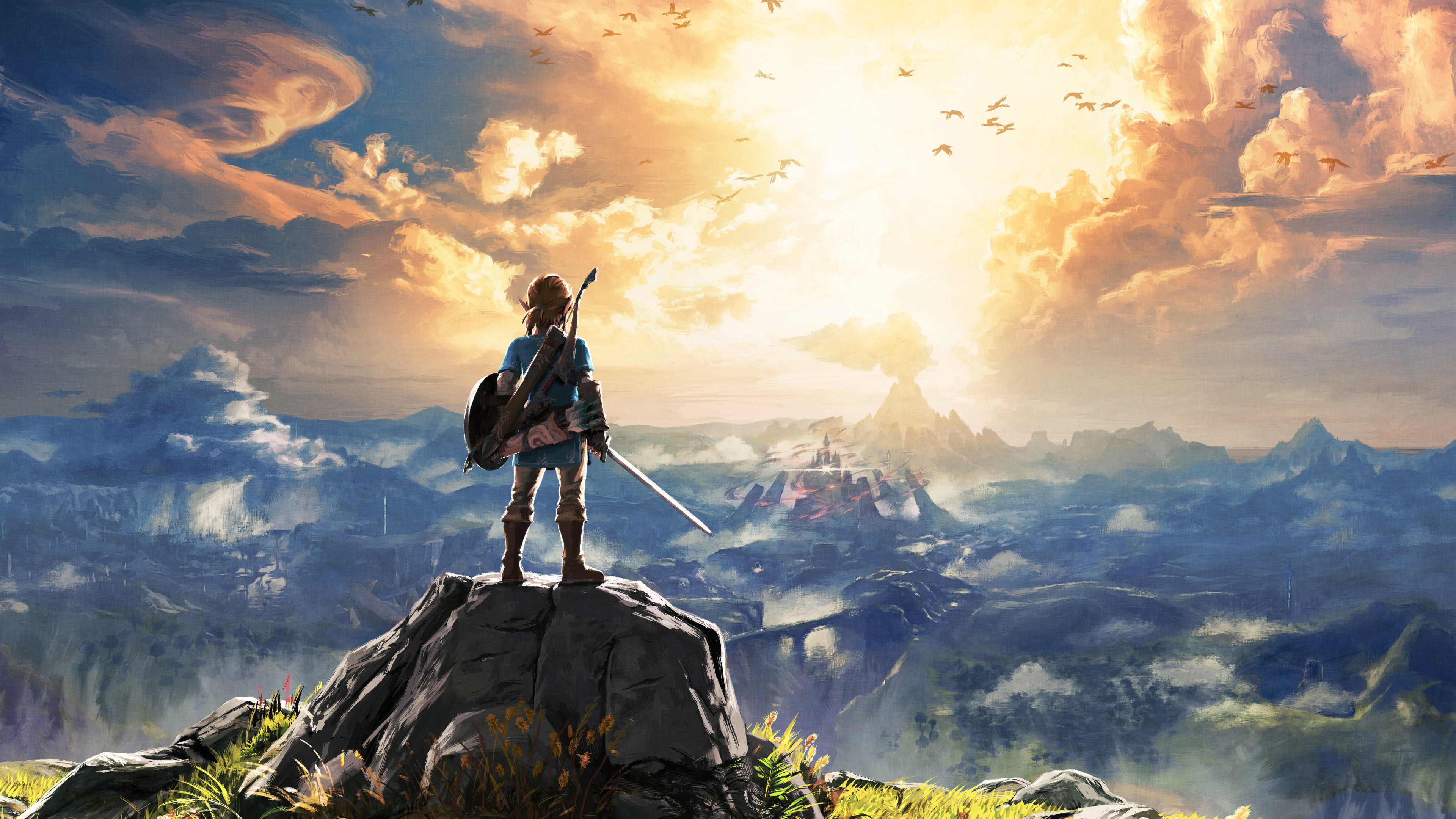
The first thing Breath of the Wild does, after you wake up with no memory in a stone chamber on a cliff, is show you the whole world. Every mountain. Every ruin. Every shimmering lake in the distance. And then — nothing. No quest marker. No blinking arrow. No tutorial box telling you to press A to continue your predetermined journey. Just the wind, the grass, and a paraglider.
My first instinct, embarrassingly, was to feel lost. I'd been playing games for two decades and had been quietly trained to look for the prompt. The arrow. The helpful NPC who would tell me exactly where to go next. Breath of the Wild has all of those things, eventually — but it doesn't offer them up front. It makes you choose. And the first time I climbed a tower just to see what was on the other side, I understood something that had been sitting in front of me my whole life.
The things you choose to do for no reason except that you want to are the things you actually remember.
The Game
The Legend of Zelda: Breath of the Wild was released in 2017 alongside the Nintendo Switch, and it quietly demolished every assumption the games industry had about open-world design. You play as Link, the hero of Hyrule, woken after a century-long slumber to find the kingdom in ruins and a malevolent force — Calamity Ganon — embedded in Hyrule Castle. Your mission, loosely: stop him. When you go, how you get there, what you do along the way — entirely up to you.
You can walk to the final boss within the first twenty minutes of the game if you want. You will almost certainly die. But you can. The game doesn't stop you. It trusts you.
That trust is the whole point.
Self-Determination Theory — The Research Behind the Freedom
In 1985, psychologists Edward Deci and Richard Ryan published the foundations of what would become Self-Determination Theory — one of the most robust frameworks in motivational psychology and now a cornerstone of educational and organisational research. The core argument is deceptively simple: humans have three basic psychological needs that, when met, produce genuine wellbeing and motivation. Those needs are autonomy (the sense that you are acting from your own will), competence (the feeling of being effective and capable), and relatedness (connection to others).
When all three are present, something shifts. You stop doing things because you have to and start doing them because you want to. The quality of engagement deepens. Learning sticks better. Creativity increases. Crucially, the experience itself becomes the reward — which psychologists call intrinsic motivation — rather than the external carrot or stick.
Breath of the Wild, probably not by accident, engineers all three. Autonomy is baked into every design decision. Competence accumulates through exploration — every shrine completed, every weapon mastered, every recipe discovered. Relatedness arrives through the villages, the characters, the fragments of a world that clearly existed before Calamity and is trying to exist again.
But autonomy is the one that changed me. Because the game's willingness to simply let me go — without instruction, without punishment for the wrong choice, without a tracker telling me I was doing it correctly — produced a quality of attention I rarely experience. Every decision felt like mine. Which meant every consequence felt like mine too. Including, occasionally, falling off a mountain I had absolutely no business attempting to climb.
Why Prescribed Paths Kill Curiosity
There's a concept in education research called overjustification — the phenomenon where providing an external reward for an activity that someone already enjoys actually reduces their intrinsic motivation for that activity. The most famous demonstration is a 1973 Stanford study where children who enjoyed drawing were given expected rewards for it. Afterwards, they drew less spontaneously than children who received no reward at all.
The reward had quietly replaced the reason. Where before the drawing was the point, now the reward was the point — and when the reward wasn't available, neither was the motivation.
I think about this every time I play a game with a progress bar. Those little percentage trackers — 37% complete, 68% complete — are doing something to the experience. They're converting exploration into achievement. Discovery into delivery. The moment you know there are 147 collectibles and you have found 92, the remaining 55 become a chore rather than a surprise. The prescription kills the curiosity.
Breath of the Wild largely refuses to do this to you. The Korok seeds — 900 of them scattered across the world — are not presented as a checklist. You find them by following your nose, by noticing something slightly odd about the arrangement of rocks, by wondering what happens if you pick up that apple and place it on that altar. The game never tells you how many you have found relative to how many exist. It just lets you be surprised.
The Real World Application
Here is the uncomfortable version of this argument: most of how we structure our working lives is the anti-Breath of the Wild. We assign tasks with deadlines and metrics and progress reports. We track completion percentages. We reward hitting targets. All of which is reasonable and necessary and also quietly corroding the intrinsic motivation of everyone involved.
The research on this is consistent and has been replicated dozens of times. Workers who feel autonomous — who feel like their decisions are genuinely theirs — are more engaged, more creative, more likely to stay, and produce better work. The paradox is that most management structures, in attempting to maximise output by controlling inputs, actually reduce the quality of both.
I'm not going to tell you to run your workplace like a Nintendo open world. That would be absurd. But there's a version of this that scales. The question worth asking — in work, in learning, in parenting, in how you structure your own days — is: where am I following the quest marker when I could be climbing the mountain because it looks interesting?
The things you choose freely, it turns out, are also the things you do best.
How do you actually play open-world games?
The takeaway: Autonomy isn't a luxury — it's a psychological need. When you give people (or yourself) genuine freedom to choose their path, the quality of attention, learning, and output changes fundamentally. Breath of the Wild understood this before most workplaces did.
A Final Note on Climbing Mountains You Weren't Supposed To
I never finished the Divine Beasts in the recommended order. I went to Vah Naboris first — the one that's supposed to be last, the electric camel in the desert that generates a permanent thunderstorm and kills you if you get within 200 metres without the right equipment. I didn't have the right equipment. It took me three hours and a lot of creative cooking to survive long enough to reach it.
It remains one of my favourite gaming memories. Not because I did it efficiently. Because I chose it. The game let me be an idiot on my own terms, and it turned out that being an idiot on your own terms is significantly more satisfying than being competent on someone else's.
Take the long way. Climb the mountain on the left. See what's over there. The quest will still be waiting.
No comments yet — be the first!