I once spent an entire Sunday doing absolutely nothing productive. No emails, no gym, no "getting on top of things." Just me, a duvet, and the ambient sound of my neighbour's dog losing its mind at a pigeon. And instead of the satisfaction I'd been promised by every wellness influencer I've ever accidentally followed, I felt quietly terrible about it. Guilty. Like I'd wasted something I couldn't get back.
This is, from what I gather, a very common experience. And it has a name.
It's called burnout. Or more specifically, the anxiety that precedes burnout, where you are so conditioned to productivity that rest itself becomes a source of stress. You can't switch off because switching off feels like falling behind, and falling behind feels like failure, and failure — well, you know where that ends up.
Enter Stardew Valley. A game about inheriting a farm. A game where the main threat is that you might go to bed slightly later than planned. A game that sold over 30 million copies because apparently a significant portion of humanity is desperate to escape to a place where the most complex problem of the day is deciding whether to water the parsnips before or after visiting the blacksmith.
I need to talk about why that is, and what it might be telling us.
The Game You Already Know About
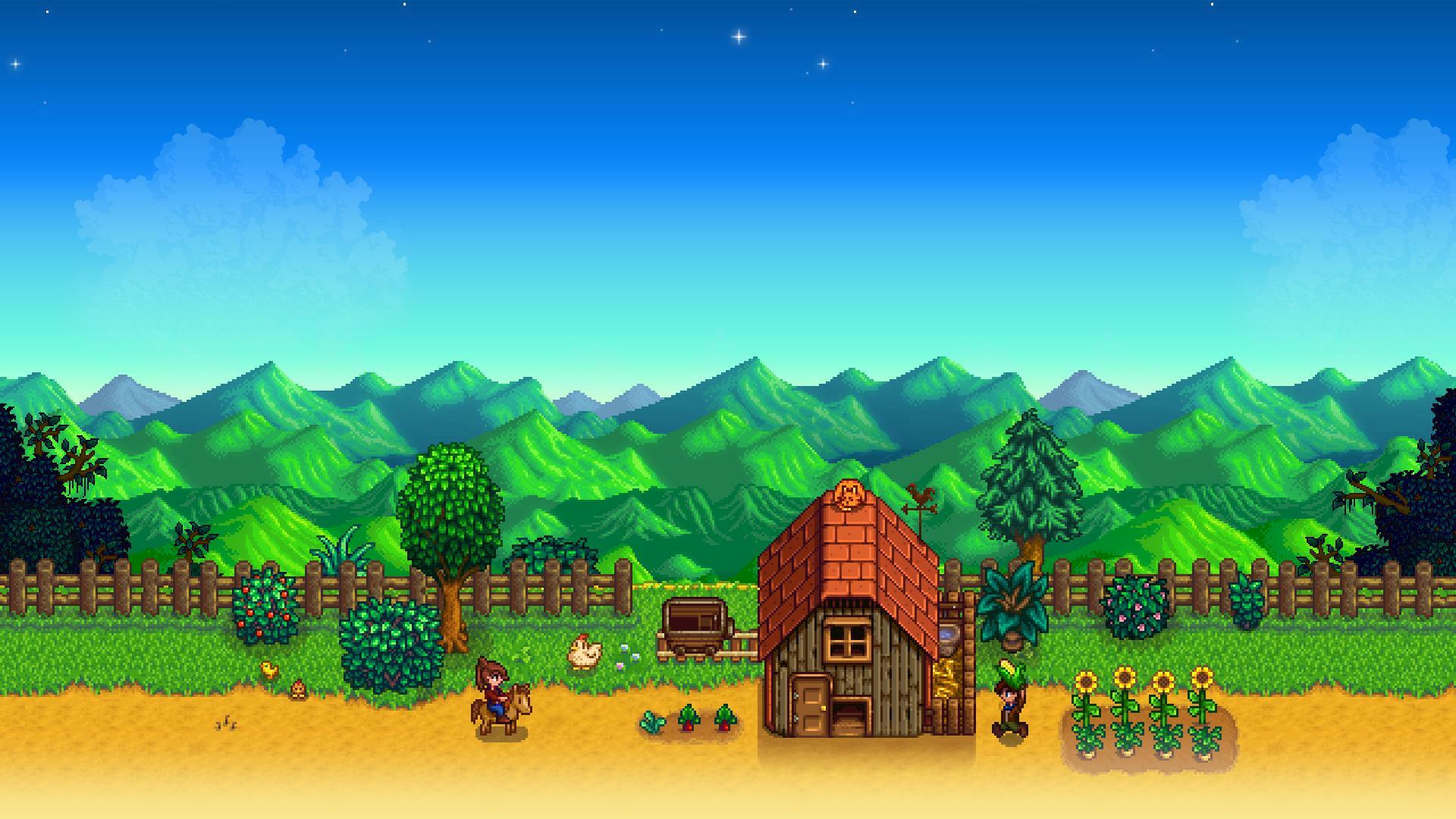
Stardew Valley was released in 2016, developed single-handedly by Eric Barone — also known as ConcernedApe — over four years of development. That's worth sitting with for a moment. One person. Four years. Thirty million copies. The game places you in the shoes of someone who quits their corporate job, inherits their grandfather's farm in a small town called Pelican Town, and begins again. No deadlines. No performance reviews. No passive-aggressive email chains about the kitchen dishwasher.
You plant crops, raise animals, fish in the river, explore a mine, befriend the townspeople, and occasionally attend a town festival where someone enters their prize turnip in a competition. The stakes are so low they're practically underground, and that — it turns out — is the entire point.
Why Your Brain Loves This
The appeal of Stardew Valley is not laziness. It's something significantly more interesting. Research published in the Journal of Occupational Health Psychology (Sonnentag & Fritz, 2007) identified four key mechanisms of psychological recovery from work stress: relaxation, mastery, detachment, and control. Stardew Valley delivers all four simultaneously, which is genuinely unusual even for leisure activities.
Relaxation — the absence of threat. Nothing in Stardew Valley wants to hurt you badly enough to actually ruin your day. Even the mine has a hospital directly next to the entrance. Someone thought of this.
Mastery — the experience of competence. Your farm gets better. Your relationships deepen. Your fishing skill — and I mean this with complete sincerity — develops at a pace that feels genuinely rewarding, even though it is fishing in a video game.
Detachment — psychological disengagement from the stress environment. You are not in your office. You are not in your emails. You are in Pelican Town, and Pelican Town does not have a Monday.
Control — the ability to choose your own activities. Nothing forces you to do anything in particular order. You can spend an entire in-game day giving gifts to villagers if you want. The game will not judge you for this. Your inbox will never be here.
When you have a completely free Sunday with no obligations, what do you actually feel?
Research note: A 2021 study in Frontiers in Psychology (Johannes et al.) found that the sense of need satisfaction during gaming — feeling autonomous, competent, and related to others — was a stronger predictor of post-game well-being than the total time spent playing. Stardew Valley's design hits all three. It's not escapism. It's structured recovery.
The Burnout Problem It's Actually Solving
The World Health Organisation classified burnout as an occupational phenomenon in 2019, defined as chronic workplace stress that has not been successfully managed — characterised by energy depletion, increased mental distance from one's job, and reduced professional efficacy. Prevalence studies vary, but a 2021 global survey found that 67% of workers reported feeling burned out more often than not during the pandemic period.
That context matters, because Stardew Valley's release in 2016 and its enormous resurgence during 2020 lockdowns are not a coincidence. People were not just bored. They were, in significant numbers, overwhelmed — and they were reaching for something that offered control, simplicity, and gentle purpose in roughly equal measure.
The fantasy of the game isn't really about farming. It's about a version of life where your effort visibly translates into progress, where the community around you notices and appreciates what you do, and where the day ends when you decide it ends. That this is a fantasy tells you something about what's missing in the non-virtual version.
The Part Where I Tell You What To Actually Do
Play Stardew Valley. I mean that straightforwardly. But also: notice what the game is giving you that your actual week is not. Because if watering digital crops for two hours on a Thursday evening is the most rested you've felt all week, that's information worth paying attention to — not about the game, but about the week.
The goal isn't to replicate Pelican Town. It's to extract the principles: some portion of the day where effort has visible results, some genuine detachment from work demands, some measure of control over how your time is spent. Stardew Valley is excellent. It's also a very gentle, very green, very tuneful diagnostic tool for your work-life ratio. What it finds is your business. What you do with that is a bit more urgent.
No comments yet — be the first!