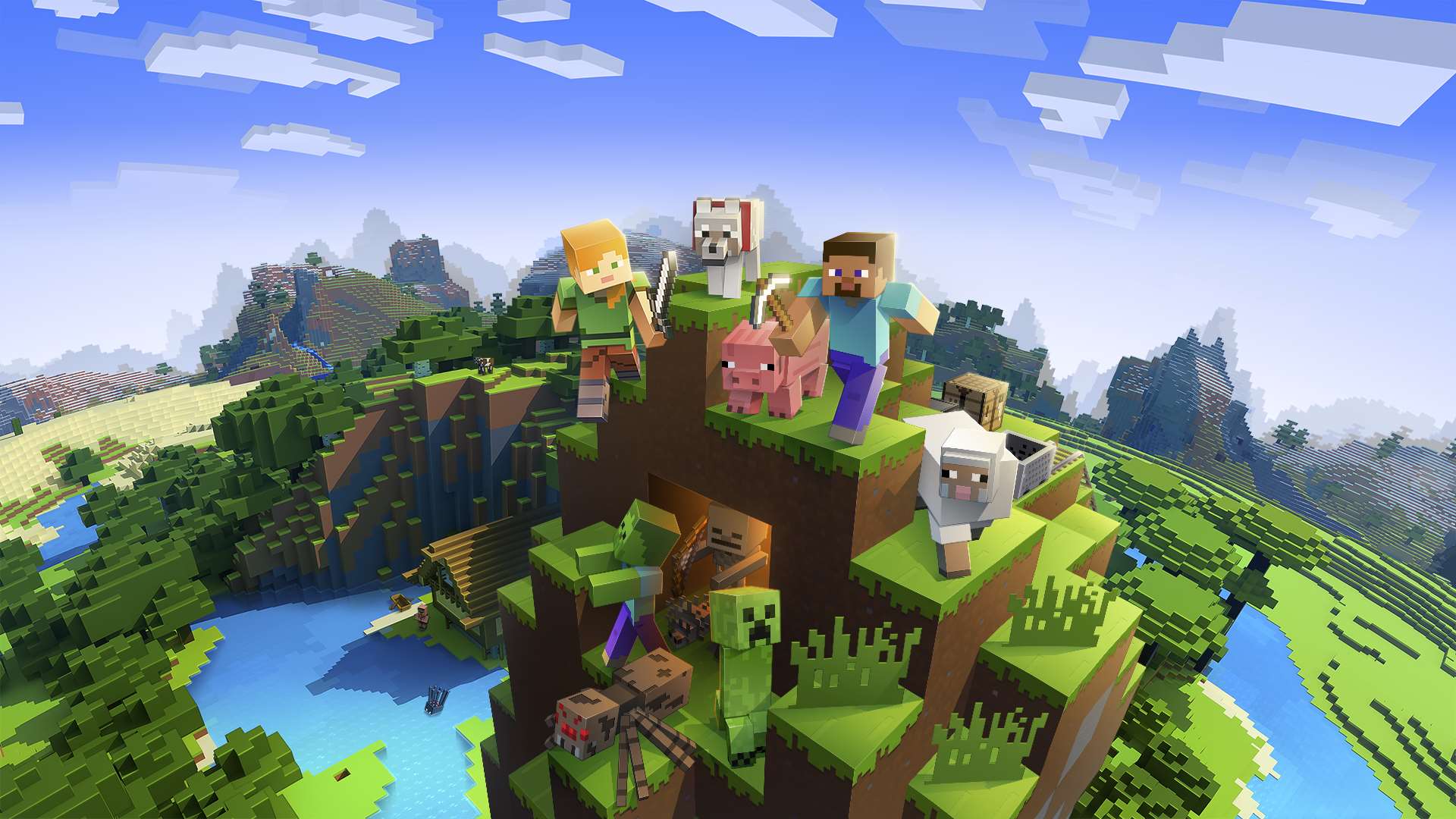
The first night in Minecraft is one of the most clarifying experiences in gaming. You have punched a tree with your bare hands, crafted a wooden pickaxe from sticks and planks, and mined a small pile of stone from a hillside. The sun is dropping. Somewhere behind you, there is a sound that is either the wind or something with teeth.
You build a box. Four walls, a ceiling, a door you're not sure how to lock. It is not beautiful. It is not ambitious. It is exactly what the situation required. Tomorrow you will do better.
That sequence — constraint, urgency, minimum viable shelter, tomorrow I'll do better — turns out to be one of the most reliable engines of creative output that psychology has identified. Minecraft didn't invent it. It just made it unavoidable.
The Game
Minecraft was created by Markus Persson, released in alpha in 2009, and purchased by Microsoft in 2014 for two and a half billion dollars — which remains one of the more startling transactions in the history of software, given that the game is mostly about cubes. It has sold over 300 million copies. It is, by most measures, the best-selling video game in history. It shows no meaningful signs of stopping.
The premise is almost insultingly simple: you exist in a procedurally generated world made entirely of one-metre blocks. You can break them and place them. You can combine materials into tools, structures, and machines of essentially unlimited complexity. There is a nominal objective — find a portal, defeat a dragon — which most players never pursue and which the game does not particularly insist upon. Mostly, you are just there.
Survival mode adds pressure: a day/night cycle that brings hostile creatures at dark, hunger that requires farming or hunting, resources that must be extracted from progressively deeper layers of the earth. Creative mode removes all of this and gives you infinite blocks and the ability to fly. It is, almost universally, less compelling than survival mode. The people who make the most extraordinary things in Minecraft — the scale recreations of Hogwarts, the working computers, the functioning cities — almost always do it in survival. Not despite the constraints. Because of them.
Why Constraints Help — The Research
Teresa Amabile at Harvard Business School has spent four decades studying what creativity actually looks like in practice — not the romantic notion of inspiration striking a lone genius, but the day-to-day conditions that make people produce original and useful work. Her findings are consistently counterintuitive to people who haven't read them.
Amabile found that intrinsic motivation — doing something because the work itself is interesting or meaningful, rather than for external reward — is the single strongest predictor of creative output. This part most people find intuitive. The less intuitive part is what she found about constraints.
Moderate constraints, rather than reducing creative output, frequently increase it. Clear scope, defined resources, real deadlines, genuine stakes — these focus attention in ways that total openness cannot. The problem with a blank page is not that it offers too little. It is that it offers too much. Every direction is equally valid. Every starting point is as good as every other. The absence of pressure to choose is itself a form of paralysis.
In a separate body of research, Patricia Stokes at Columbia studied the careers of major artists — Monet, Picasso, Klee — and found that the work that broke new ground was almost invariably produced during periods of deliberate self-constraint. Monet's haystacks series, his cathedrals, his water lilies: the same subject, over and over, different light. The constraint of the repeated subject forced the innovation. Without it, each painting could have been anything — and often was, producing work that was accomplished but not generative.
The psychological mechanism behind this is relatively well understood. Constraints reduce the search space of possible approaches, which reduces the cognitive overhead of getting started, which makes it easier to enter what Mihaly Csikszentmihalyi called flow — the state of absorbed, effortless-feeling engagement where the best work tends to happen. Open-ended tasks, by contrast, keep the mind in a planning and evaluating mode that is incompatible with the kind of unselfconscious making that produces genuinely original work.
The Grid Is the Constraint
Minecraft's fundamental constraint is the cubic grid. Everything exists in one-metre blocks. You cannot build at an angle. You cannot have a curved wall unless you approximate it with steps at sufficient scale. Every organic shape has to be translated into the blocky language of the game's geometry, which means every building project involves a continuous series of small decisions about how to express the idea you have within the vocabulary available to you.
This is exactly how creative constraints work at their best. They don't block the idea — they force you to figure out what the idea actually is. When you can't have a curved arch, you have to decide: is the arch essential, or is what I really want the sense of grandeur it implies? If grandeur, there are other ways. If arch specifically, then we're going to need a lot of blocks and a lot of patience.
The grid also creates a shared aesthetic language that the Minecraft community has developed over fifteen years of collective problem-solving. Certain block combinations suggest wood-and-stone medieval architecture. Others suggest brutalist concrete. Others suggest neon cyberpunk. The constraint that every builder works within the same vocabulary means that techniques and solutions accumulate and circulate — a kind of creative commons of approaches that any player can learn from and build on.
This is the social dimension of constraint that Amabile's research also touches on: creative communities develop around shared constraints because the shared vocabulary makes communication, teaching, and mutual improvement possible. Jazz musicians improvise within harmonic and rhythmic constraints. Sonnets have fourteen lines and a rhyme scheme. Haiku have seventeen syllables. The constraint is not a cage — it is the arena in which the conversation happens.
Survival Mode Is the Better Mode
Creative mode in Minecraft is a powerful tool for planning and testing large projects. Almost no one uses it exclusively. The reason is psychological and it maps precisely onto what the research predicts.
In creative mode, there are no stakes. You cannot die. Resources are infinite. Nothing you build was difficult to acquire. The result is that nothing you build feels particularly earned — and the feeling of having earned something turns out to be a significant component of creative satisfaction. Csikszentmihalyi's flow research found that the optimal experience requires a balance between challenge and skill: too easy produces boredom, too hard produces anxiety, but the zone where difficulty and capability are roughly matched produces engagement that feels intrinsically rewarding.
Survival mode keeps you in that zone almost by design. Early game, your skills are limited and so are the challenges — survive the night, find food, get iron. Mid game, both scale up together. Late game, you have the capability to attempt genuinely ambitious projects and the accumulated knowledge of the game's systems to execute them. The progression is not arbitrary. It is the structure that makes long-term creative investment feel worthwhile.
There is also something to be said for what scarcity does to design decisions. In creative mode, if you want more of a particular block, you just take it. In survival, certain materials are rare. You might have a clear vision for a build but insufficient resources to execute it at the scale you imagined — which forces you to either scale down, substitute, or wait and plan. Substitution especially produces some of the most interesting design outcomes: reaching for a different material because you don't have enough of the one you wanted, and discovering that the alternative was actually better.
The Blank Canvas Problem
There is a specific creative failure mode that Minecraft's design prevents almost entirely, and which is responsible for a significant amount of real-world creative stagnation. It is sometimes called the blank canvas problem, sometimes the tyranny of choice, sometimes just the paralysis that precedes starting anything.
It works like this: you want to make something. You have all the time and resources you need. You sit down. Nothing happens. The very abundance of possibility produces a kind of cognitive gridlock — every option cancels out every other option, and the mind keeps deferring the actual work in favour of more planning, more research, more preparation. The work never starts because it never needs to start yet. There is always more time. There is always a better approach to find first.
The first night in Minecraft cuts through all of this. You do not have time to plan a beautiful house. You have time to not get eaten. The constraint is not frustrating — it is liberating. It tells you exactly what to do: build something, now, with what you have. The result will be crude. That's fine. Crude things can be improved. Nothing cannot.
Barry Schwartz's paradox of choice again: when the options are constrained, people commit and execute. When they are unlimited, people hesitate, over-plan, and often produce nothing at all. The box you build on night one is worse than what you could theoretically build. It is infinitely better than the house you might build someday when conditions are more favourable.
When working on a creative project, what helps you most?
The takeaway: Constraints are not the obstacle to creative work — they are usually the prerequisite for it. The question to ask when you're stuck is not "how do I get more freedom?" but "what are the actual limits here, and how do I work brilliantly within them?" The first night's box is not a failure of ambition. It's where ambition begins.
What To Take Away From a Children's Game About Cubes
Minecraft is frequently dismissed as a children's game, which it partly is. It is also one of the most sophisticated sandboxes for applied creative thinking that has ever been made available for the price of a cinema ticket.
If you are a person who makes things — writes, designs, codes, builds, composes, paints, plans — and you regularly find yourself stuck at the beginning, or unable to commit to a direction, or perpetually waiting for the right conditions before you start, the lesson from Minecraft research and creativity research alike is the same: impose a constraint. Pick one. Make it real. Build the box.
It does not need to be a good box. It needs to exist. Everything improvable has to exist first. And the night is coming.
No comments yet — be the first!