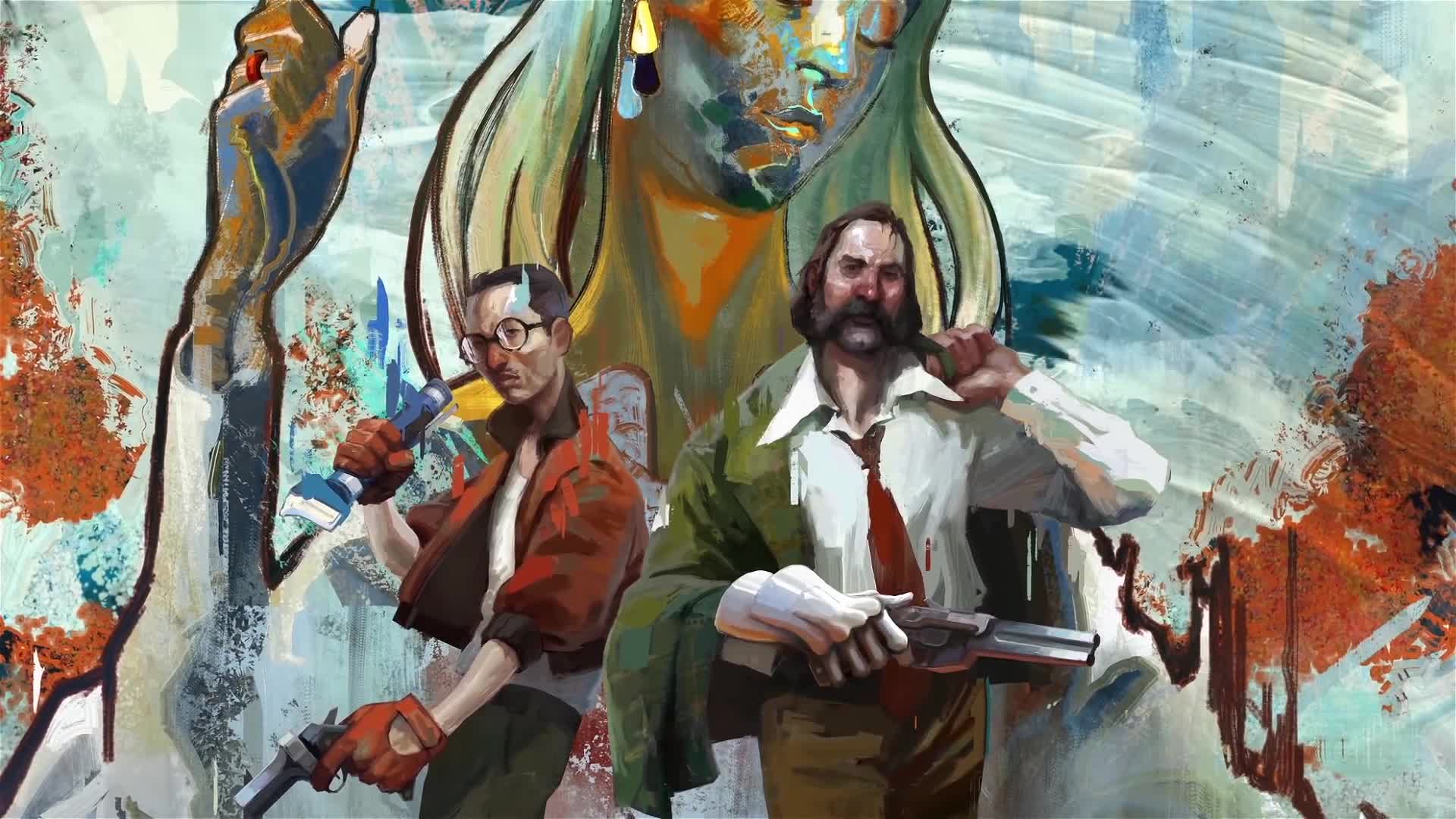
You wake up on the floor. You have no idea who you are. Your tie is on the ceiling fan. There is a woman outside your door who wants to know if you are coming to investigate the body in the courtyard, and you cannot find your shoe.
Before you take a single step, Disco Elysium gives you an argument. Electrochemistry suggests you check the minibar. Volition says you should focus. Inland Empire insists something is deeply wrong about this room. Encyclopedia wants to tell you about the history of the Martinaise district. Shivers is having what can only be described as feelings about the weather.
This is not a tutorial. This is the game's entire thesis, delivered in the first two minutes: you are a person made of competing voices, and most of what you experience as thinking is actually several of them shouting at once.
The Game
Disco Elysium was released in 2019 by ZA/UM, a studio led by Estonian novelist Robert Kurvitz. It was later expanded into a Final Cut version with full voice acting in 2021. It won almost every major award in the year of its release, then became one of the most discussed games of the subsequent half-decade — not for its mechanics, which are essentially a tabletop RPG translated into a computer, but for what it was willing to say.
You play Harry Du Bois: a detective, probable alcoholic, definite disaster, who has drunk himself into total amnesia. You do not know your name, your past, your ideology, or your taste in music. The game asks you to figure all of this out while simultaneously solving a murder in a decaying harbourside district of a city that is still coming to terms with a failed communist revolution from decades ago.
Your character is built from 24 skills, divided into four categories: Intellect, Psyche, Physique, and Motorics. Each skill has a name and a personality. They interrupt conversations. They comment on your choices. They beg you to pursue their particular angle on every situation. Raise a skill high enough and it becomes louder, more insistent — a voice that keeps cutting in, convinced it has the answer, even when you're trying to think about something else entirely.
You cannot turn them off.
Decision Fatigue — The Research
In 1998, Roy Baumeister and colleagues at Case Western Reserve University ran a now-famous experiment. Participants were placed in front of a plate of fresh-baked cookies and a bowl of radishes. Some were told to eat only the radishes. Others could eat freely. All were then given a difficult geometry puzzle to work on.
The radish group gave up on the puzzle significantly sooner. Not because the puzzle was harder for them. Because resisting the cookies had depleted something. Baumeister called it ego depletion — the finding that self-control, decision-making, and directed mental effort all draw from a finite cognitive resource. Use it up resisting one thing, and you have less available for the next.
Later research complicated the original model. The precise mechanism is still debated. But the phenomenological finding — that making many decisions degrades the quality of subsequent ones, that willpower has something like a budget — has been replicated across enough contexts to be taken seriously. Judges give harsher parole decisions later in the day. Surgeons make more errors toward the end of long procedures. Shoppers make worse purchasing choices after extended browsing.
Barry Schwartz formalised a related concept in his 2004 book The Paradox of Choice: when given more options, people frequently become less satisfied with whichever one they choose, and often choose nothing at all rather than risk making the wrong decision. More choice, counterintuitively, produces paralysis and dissatisfaction rather than freedom and contentment.
Disco Elysium is a playable demonstration of both phenomena simultaneously. Every skill check is a decision. Every dialogue option forks into further decisions. Every ideological position opens ten more questions. The game never lets you reach a state of certainty — every answer generates new voices with new objections — and if you have ever stared at a dialogue tree for three minutes without being able to pick an option because all of them seem wrong in different ways, you have experienced choice paralysis in a controlled environment.
The Voices Are You
The most interesting thing about Disco Elysium's skill system is not that your skills argue with you. It's that they are all correct, partially, simultaneously.
Electrochemistry is right that the minibar is calling you. Volition is also right that ignoring it is worth trying. Inland Empire is correct that something feels wrong. Encyclopedia is accurate about the history. None of them is lying. None of them is the voice you should simply always obey. The problem is not that one of your internal voices has bad information — it's that you have too many voices with good information, and no clear hierarchy for deciding which one gets to speak this time.
This maps precisely onto what clinical psychologist and researcher Steven Hayes calls psychological inflexibility — the condition that underlies most anxiety, depression, and self-defeating behaviour. Not that your thoughts are wrong. But that you are fused with them: unable to step back from any individual thought and choose which one to act on, because all of them feel equally urgent and equally real.
The antidote Hayes identifies, in Acceptance and Commitment Therapy, is something called defusion: the ability to notice a thought as a thought rather than as a command. To hear the voice, acknowledge it, and then decide consciously whether to follow it or set it aside. Disco Elysium's protagonist, over the course of the game, must develop exactly this skill. You learn which voices are useful in which contexts. You learn to hear Electrochemistry without immediately obeying it. You learn that Shivers, for all its apparent irrelevance, occasionally tells you something the other skills cannot.
This is not a straightforward hero's journey. Harry does not become someone who makes great decisions. He becomes someone who makes slightly more intentional ones. That is, realistically, the best outcome available.
The Ideology Problem
Where Disco Elysium goes further than most psychological frameworks is its treatment of ideology — the political and philosophical identity the player constructs for Harry over the course of the game.
The game offers four broad ideological paths: Communism, Fascism, Moralism, and Ultraliberalism. None of them is presented as correct. Each of them has articulate, intelligent spokespeople. Each of them has also clearly failed in some identifiable way in the world the game depicts. And crucially, each of them offers the same thing: the relief of having a framework that resolves ambiguity, a set of answers you can give automatically without having to think from scratch every time.
The game is deeply suspicious of this relief. Characters who have committed fully to an ideology are shown to have traded complexity for clarity — and to have paid a price for it, usually in their relationships, their honesty, or their ability to see things they don't want to see. The characters who seem most functional are not the true believers but the ones who have learned to hold their convictions without being fully held by them.
This is an uncomfortable observation to make about human psychology, because the research on cognitive load suggests ideology is adaptive: it is genuinely cognitively costly to evaluate every situation from first principles, and having default positions saves mental bandwidth. The question the game poses is not whether to have views, but whether you are using them to think or to avoid thinking.
What To Do With This
Decision fatigue research has some practical suggestions, most of which are obvious in retrospect: make important decisions early in the day, reduce trivial choices to preserve capacity for significant ones, create routines that bypass the decision entirely wherever you can. These are useful. They are also slightly beside the point.
The deeper problem Disco Elysium is pointing at is not one of scheduling. It is one of relationship with your own thinking. Most people in states of choice paralysis are not overwhelmed by the options in front of them — they are overwhelmed by their own internal commentary on each option. The voices pile up. No single one seems authoritative. Every potential choice immediately generates a counterargument. And eventually the safest thing is to do nothing and keep all options open indefinitely, which is itself a choice with consequences.
Noticing this pattern — recognising the committee meeting happening in your head as a committee meeting rather than as the one true voice of reason — is not a solution. But it is the beginning of one. Harry Du Bois, standing on the floor of a ruined hotel room, with no idea who he is and seventeen skills arguing about what to do next, has no option but to notice. He picks one voice. He acts. It might be wrong. He finds out. He picks another voice next time.
That's not a bad model for getting through a day.
When you're facing a difficult decision, what usually happens inside your head?
The takeaway: Decision fatigue is not a character flaw — it is a structural feature of how cognition works. The goal is not to silence the competing voices. It is to stop confusing the loudest one with the correct one. Pick one. Act. Find out. The uncertainty doesn't go away, but it becomes more manageable once you stop trying to resolve it before you move.
Play It Alone, at Night, Slowly
Disco Elysium is not a game that benefits from being rushed. It is dense, literary, occasionally extremely funny in the way that only things about terrible sadness can be, and structured around a world that reveals itself gradually through accumulated dialogue and observation rather than action sequences.
It is also the only game I have encountered that made me feel, on several occasions, that someone had read my therapy notes. Not because Harry Du Bois is me. But because the architecture of his problem — too many voices, no clear authority, a history he can't access and a future he can't commit to — is recognisable in a way that is more useful than flattering.
Some of your skills will be high. Some will be low. The game does not let you be good at everything. It makes you decide who you are, in small choices, repeatedly, under pressure, with imperfect information. Which turns out to be an accurate description of most Tuesdays.
No comments yet — be the first!