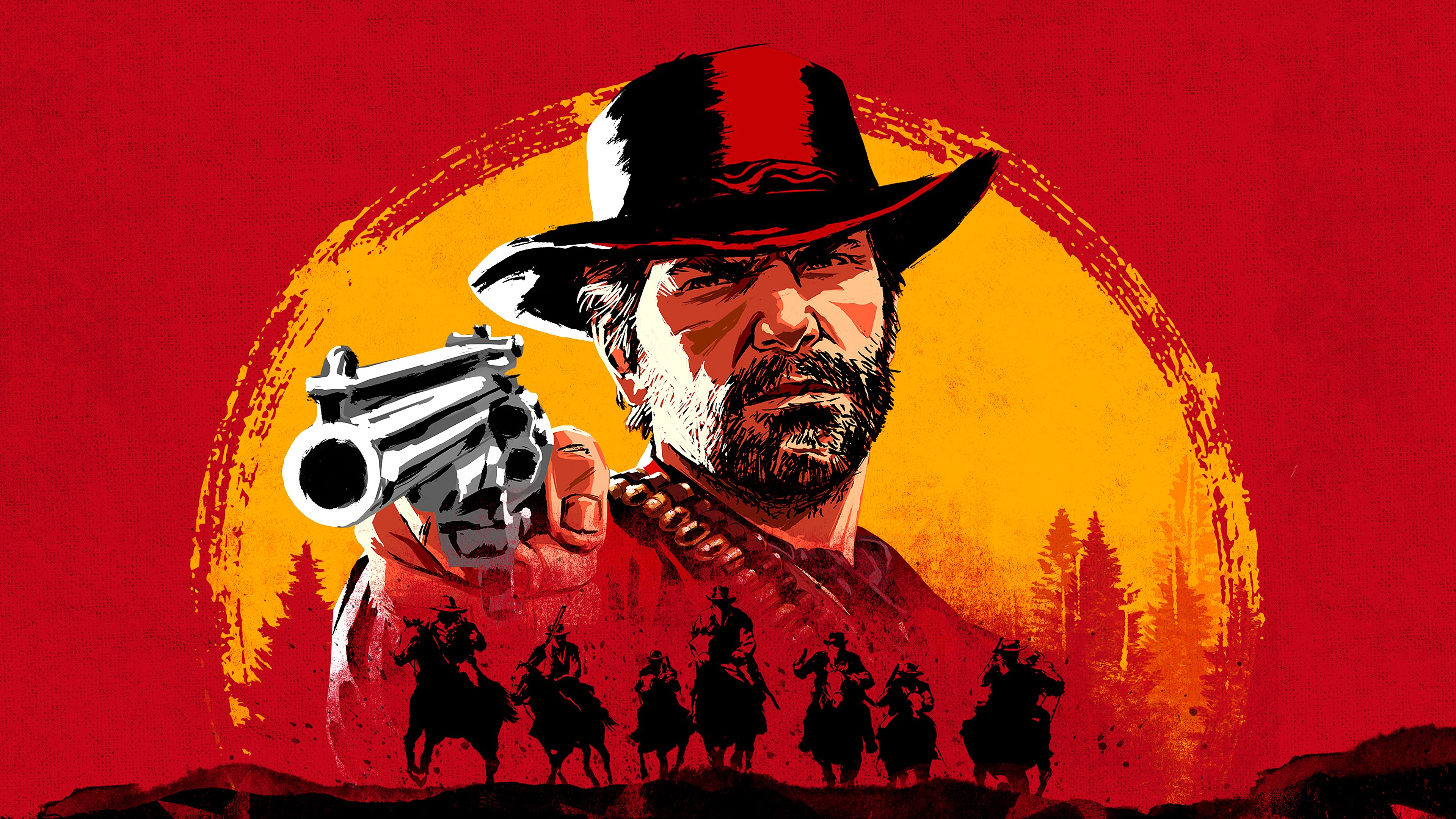
The horse animation in Red Dead Redemption 2 has been called, variously, the most beautiful thing in video games and the most infuriating. Arthur Morgan does not teleport onto his horse. He grabs the saddle. He puts his foot in the stirrup. He swings himself up. If you press a button mid-animation, nothing happens. The animation continues. You wait.
The first time I did this, I was annoyed. By hour fifty, I realised I had stopped noticing. Not because I had become numb to it, but because I had slowed down enough to match the game's rhythm. I was watching the heron lift off the swamp as the horse splashed through. I was listening to Arthur's breathing. I was in no particular hurry to arrive anywhere.
This is either brilliant game design or an elaborate psychological experiment. Possibly both.
The Game
Red Dead Redemption 2 was released by Rockstar Games in 2018. It is set in 1899 and follows Arthur Morgan, enforcer for the Van der Linde gang — a group of outlaws who are, somewhat reluctantly, running out of time. The frontier is closing. Lawmen are closing in. The world that made the gang possible is disappearing, and Dutch van der Linde, the gang's charismatic leader, keeps promising that one last big score will give them enough money to disappear somewhere free and peaceful. It never does.
The game is enormous: between sixty and eighty hours for a focused playthrough, considerably more if you engage with its many side systems. The map is vast and mostly traversed on horseback at speeds that feel, relative to modern open-world games, genuinely slow. You can fast travel, but the game discourages it — partly through inconvenience, and partly because fast travelling through RDR2 feels like the wrong answer to the question it is asking.
Mechanically, it asks you to do a great many things in real time that other games would skip: skinning animals, cleaning your weapons, cooking meat over a campfire, grooming and feeding your horse. None of these are optional activities. Your horse bonds with you more strongly if you brush it and talk to it. Your weapons jam if you neglect them. Arthur's camp morale drops if you don't bring supplies. The game requires presence in a way that feels almost confrontational to the contemporary gamer instinct of always optimising, always skipping to the next thing.
Waiting — The Research
In the late 1960s, psychologist Walter Mischel began a series of experiments at Stanford that became some of the most cited findings in developmental psychology. Children were placed alone in a room with a marshmallow — or another preferred treat — and told that if they could wait fifteen minutes without eating it, they would receive a second one. About a third of children held out for the full duration.
Follow-up studies tracked these children over decades. Those who had been able to delay gratification at age four showed markedly better outcomes across multiple measures in adolescence and adulthood: higher standardised test scores, lower rates of substance abuse, greater capacity to manage stress and frustration, higher self-reported wellbeing. The ability to wait, in some meaningful sense, predicted who they would become.
The original findings have been substantially complicated since. Later researchers pointed out that the study's sample was small and unrepresentative, and that much of the variance in outcomes could be explained by socioeconomic background — children from more stable, trusting environments were simply more likely to believe the promise of a second marshmallow. Delaying gratification when you have learned that promises tend not to be kept is irrational, not impulsive. The relationship between patience and outcomes is real but less clean than early reporting suggested.
What held up was the more fundamental observation: that the capacity to choose a larger, later reward over a smaller, immediate one is a meaningful cognitive skill. And that this skill has become, in the environment many of us inhabit now, increasingly difficult to practise and maintain.
We live in an infrastructure of immediate reward. Streaming services remove the week between episodes. Search engines answer questions before the sentence is finished. Delivery services close the gap between wanting and receiving to hours. None of this is sinister — convenience is genuinely good. But capacity, like muscle, atrophies without use. The ability to sit with wanting something without immediately acting on that want is a form of tolerance that requires regular exercise, and most of the environments we inhabit are not designed to provide it.
Arthur Morgan Is a Lesson in Not Waiting Long Enough
The central irony of RDR2 is that the game requires tremendous patience from the player while depicting a man who keeps failing to exercise it himself.
Arthur Morgan knows, by the game's midpoint, that Dutch is not going to lead them to freedom. The evidence accumulates plainly. The plans keep failing. The violence keeps escalating. The promised destination keeps moving. Arthur sees it. He says it. And then he follows Dutch anyway, for reasons that are deeply human and deeply understandable — loyalty, inertia, the sunk cost of a life already committed — but that keep deferring the one decision that would actually help him.
The long-term reward Arthur keeps failing to choose is not money. It's survival — and more than that, a version of himself he could live with. The short-term reward he keeps choosing is the familiar: the gang, the loyalty, the sense of belonging to something even as that something rots. This is not stupidity. This is how most of us operate most of the time. The comfortable known is chosen over the difficult uncertain with a consistency that no amount of knowing-better seems to override.
Psychologist Walter Mischel, in his later work, argued that the children who succeeded in the marshmallow test were not simply better at suffering through wanting. They were better at reframing: looking away from the marshmallow, imagining it as a picture of a marshmallow rather than the thing itself, thinking about something else entirely. Willpower exercised as brute suppression tends to fail. Willpower exercised as redirection tends to succeed.
Arthur Morgan never learns to redirect. He keeps looking at the marshmallow — the gang, Dutch's promises — and trying to want it less while staying right in front of it. The game makes you watch this with agonising patience, in beautiful real time, on a horse that climbs into the saddle one careful move at a time.
The Deliberate Slowness Is the Point
There is a moment in RDR2 — available only if you ride out of your way, at a particular time of day — where you can watch a herd of elk cross a river at sunset. Nothing happens. There is no reward. Arthur says nothing. The elk cross. The water catches the light. It takes about three minutes.
This is the game's argument in its most compressed form: the thing you were not rushing toward is still here. You have the capacity to notice it. Most of what the modern world asks of you is designed to make sure you don't.
The research on what psychologists call savoring — the deliberate extension and appreciation of positive experience — shows consistently that it increases wellbeing, reduces anxiety, and deepens the felt quality of life. It is also, by most accounts, something people become worse at as they spend more time in high-stimulus, high-interruption environments. The skill degrades from disuse. RDR2 is structured as an attempt to restore it, chapter by agonising, gorgeous chapter.
What To Do With This
The practical literature on delayed gratification mostly focuses on tactics: commitment devices, implementation intentions, reducing friction on better choices. These work. But RDR2 is pointing at something slightly more interesting than tactics — at the question of what you are waiting for.
Arthur Morgan's problem is not that he cannot delay gratification. It's that he has never made a clear decision about what the gratification he is waiting for actually is. The gang is the immediate comfort; the free life somewhere is always the vague future good; and the distance between those two things is where he lives, making small compromises and large ones, until the distance becomes fatal.
Knowing what you are waiting for is, it turns out, the prerequisite for being able to wait. Patience exercised in service of a clearly understood goal feels different from patience endured while avoiding a choice. One is a capability. The other is paralysis given a heroic name.
Arthur spends most of a hundred-hour game learning this distinction too late. You watch it happen from the back of a horse, at a walk, in real time, as the sun sets over the frontier. The destination was never the point.
When it comes to delayed gratification, what do you struggle with most?
The takeaway: Patience is not the absence of desire — it's desire organised around something worth waiting for. Arthur Morgan keeps waiting for Dutch to change, which is the wrong thing to wait for. Knowing the difference between the marshmallow in front of you and the one worth waiting for is the work. RDR2 gives you sixty hours on horseback to think about which one is which.
Play It Without Fast Travel
Red Dead Redemption 2 is a game that only makes sense if you agree to its terms. Fast travel it, skip the cutscenes, ignore the ambient systems, and you have an above-average open-world action game with excellent gunplay and a sad ending. Submit to its pace — actually ride the horse, actually skin the elk, actually sit at the campfire and listen to the gang sing — and it becomes something that is harder to explain but easier to remember.
It will take you a long time. It will occasionally frustrate you. Arthur Morgan will climb into his saddle at his own speed, regardless of how many buttons you press. And at some point, if you let it, the game will stop feeling slow and start feeling like the right speed. Which is the same thing it's been trying to say all along.
No comments yet — be the first!