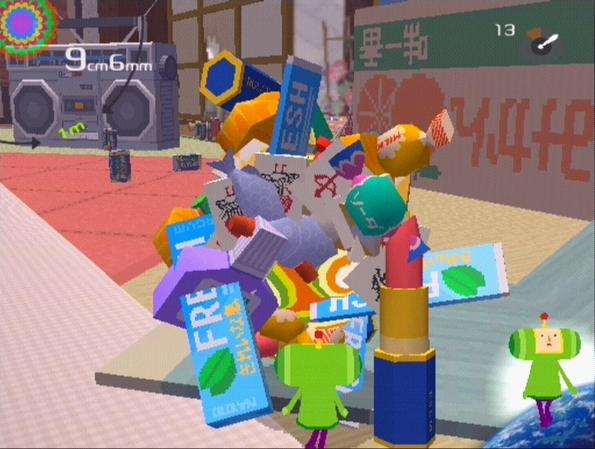
The first time I played Katamari Damacy I was at a friend's house, waiting for other people to arrive, and I was handed a controller and told to "just roll around for a bit." Twenty-five minutes later, everyone else had arrived, my coat was still on, and I had collected the following: several hundred thumbtacks, a number of dice, an entire sushi restaurant's worth of ingredients, two koi fish, a frog, a moderately sized dog, a park bench, and a human being named Macho Takahiro who presumably had somewhere else to be. I had not noticed any of this happening. I had been somewhere else — somewhere deeply inside the rolling — and the party had assembled around me and I had simply not registered it, because the rolling required all of me and it was using all of me and for twenty-five minutes I had been, in the strictest psychological sense, completely present.
Flow is the word Mihaly Csikszentmihalyi coined for this experience — the state of complete absorption in a challenging activity, the loss of self-consciousness, the alteration of time perception — and he spent approximately thirty years documenting it across chess players, surgeons, rock climbers, factory workers, and musicians before anyone thought to apply it systematically to video games. Katamari Damacy, released in Japan in 2004 and designed by the magnificent eccentric Keita Takahashi, is one of the cleanest flow-induction mechanisms ever put into a game cartridge, and it achieves this almost by accident, through the purity of its design.
The question worth asking is not just why the game produces flow, but what that tells us about when we're most alive in our ordinary, non-katamari-related lives.
The Game
Katamari Damacy was designed by Keita Takahashi for Namco and released in 2004. The premise is immediately legible: your father, the King of All Cosmos, has accidentally destroyed all the stars while drunk, and you — the Prince, approximately five centimetres tall — must roll a sticky ball called a katamari around Earth collecting objects until the katamari is large enough to be launched into the sky and become a celestial replacement. Each level starts small — collecting thumbtacks and eraser caps — and the katamari grows until you're picking up buildings, mountains, and clouds. The challenge scales continuously: as you grow, the things you can pick up grow, and the things that are too large to pick up remain threatening until you're big enough for them too.
The game makes no demands on narrative comprehension, has no complicated control scheme, and offers no choice trees or moral complications. It is, in its bones, a pure mechanical experience: the feedback between your size, the environment, and the escalating possibility space. The soundtrack is bright, strange, and relentless, and the whole thing has the quality of a fever dream that has somehow been made extremely playable. Takahashi has since said he was trying to make something that would make people want to go outside, which is an ambition the game accomplishes despite being very good at keeping people inside. He is a complicated man.
The Channel Between Boredom and Anxiety — The Research
Mihaly Csikszentmihalyi — pronounced, for those who have been avoiding saying his name aloud, roughly "cheeks-sent-me-high" — began studying optimal experience in the 1960s by interviewing artists about what it felt like to be doing their best work. What he found, consistently, was a description of an experience that had nothing to do with happiness in the conventional sense: not relaxation, not pleasure, not satisfaction, but a state of complete absorption in which self-consciousness disappeared, time distorted, and the activity felt intrinsically worth doing for its own sake. He called this flow, borrowing the term from the artists themselves who kept using water metaphors.
His subsequent research — summarised in the 1990 book Flow: The Psychology of Optimal Experience — documented the same state across an enormous range of activities and cultures. The conditions that reliably produce it are specific: the activity must have clear goals, must provide immediate feedback, and most critically, must present a challenge that precisely matches the person's current skill level. Too easy and the activity produces boredom; too difficult and it produces anxiety. In the narrow channel between boredom and anxiety — where the challenge is high enough to require full engagement but not so high as to overwhelm — flow occurs. Csikszentmihalyi called this the flow channel.
The research on wellbeing that accompanied this work produced a counterintuitive finding: people do not report their highest levels of engagement and meaning during leisure and rest. They report them during challenging, structured activity. The passive pleasures — watching television, lying on the sofa — score lower on measures of engagement and positive affect than activities that require skill and produce feedback. This is not an argument against rest; rest is necessary and has its own value. It's an observation that the human system is designed to find its greatest aliveness in the doing of difficult things, and that arranging your life to minimise challenge is, paradoxically, not the route to wellbeing.
Why Katamari Is a Flow Machine
Katamari Damacy hits almost every condition Csikszentmihalyi identified with unusual precision. The goal is always clear: reach the target size by the end of the timer. The feedback is immediate and unambiguous: the katamari either picks something up or it doesn't, and you can see the size counter incrementing in real time. And the challenge-skill balance is dynamically maintained by the game's central mechanic: as you grow larger, previously impossible objects become accessible, the play space effectively expands, and new threats appear that weren't threats when you were smaller. You never stay in the same skill zone for more than a few minutes. The game is continuously recalibrating the challenge to your current capability, which is the design equivalent of what good teaching looks like and what most human activities conspicuously fail to do.
The self-consciousness loss is particularly striking. Katamari doesn't ask you to think about yourself — the camera is objective, the prince is a vehicle, and there are no narrative decisions to make about who you are or how you feel. You are purely the rolling. This is, Csikszentmihalyi's research suggests, the structural condition for the loss of self that flow produces: when the activity demands all of your cognitive capacity, there is nothing left for the monitoring self to do. The inner voice that usually provides running commentary on your performance, your adequacy, your relationship to what you're doing — it goes quiet, because the rolling needs those resources and they're already in use.
Finding the Channel in Real Life
The flow research has a practical implication that is both simple and, for many people, structurally difficult: the activities most likely to produce genuine engagement and wellbeing are those that sit at the edge of your current competence. Not comfortably within it — those produce boredom. Not overwhelmingly beyond it — those produce anxiety. Right at the limit, where the doing requires full attention and the outcome is uncertain, where you might fail but you might also pull it off. This is where chess players, surgeons, and small princes rolling balls all end up feeling most alive.
What this means practically varies by person and context. For some it's the skill at work that's being stretched; for others it's music, or sport, or conversation at the edge of their emotional capability. The specifics matter less than the structural condition: challenge matched to skill, clear goals, immediate feedback, and the willingness to put yourself in situations where failure is possible because those are the only situations where flow is possible too. Katamari achieves this in a game about rolling a ball into a frog. The principle scales upward from there.
When do you most reliably lose track of time in a good way — the flow state that swallows an afternoon?
What To Do With This
The flow channel is not a mystical state available only to exceptional people doing exceptional things. Csikszentmihalyi's research found it in factory workers doing repetitive tasks who had learned to introduce micro-challenges into their routine, in teenagers playing video games, in retired people tending gardens. The conditions are the conditions: clear goal, immediate feedback, challenge at the edge of skill. If your life contains activities that reliably hit those conditions, protect them. If it doesn't, the question worth asking is what would need to change — not necessarily in the activity, but in how you approach it. Deliberately increasing the challenge of something you've become comfortable with is often enough to reopen the flow channel. The katamari that's too big for the room is no longer in flow. It needs a bigger room, or a new challenge, or to go outside and try rolling up a weather system.
The takeaway: Mihaly Csikszentmihalyi's research on flow identified the state of complete absorption in challenging activity as the source of peak engagement and wellbeing — produced when challenge is precisely matched to skill. Katamari Damacy's central mechanic continuously recalibrates this balance as the player grows, making it one of the most structurally elegant flow-induction mechanisms in gaming. The principle it demonstrates — that the narrow channel between boredom and anxiety is where humans feel most alive — scales beyond games into every domain where skill meets challenge.
Play It Loud
Katamari Damacy Reroll is the remastered version and is available on PC, Switch, and console. Play it with the sound up — the soundtrack is absurd and joyful and an integral part of the experience, and playing it on mute is like watching fireworks through a window. Start a level, give it five minutes, and notice the moment you stop thinking about anything except the rolling. That moment — the precise transition from "I am playing a game" to "I am the rolling" — is what Csikszentmihalyi spent three decades trying to describe. You'll feel it. It takes about four minutes and a medium-sized dog.
No comments yet — be the first!