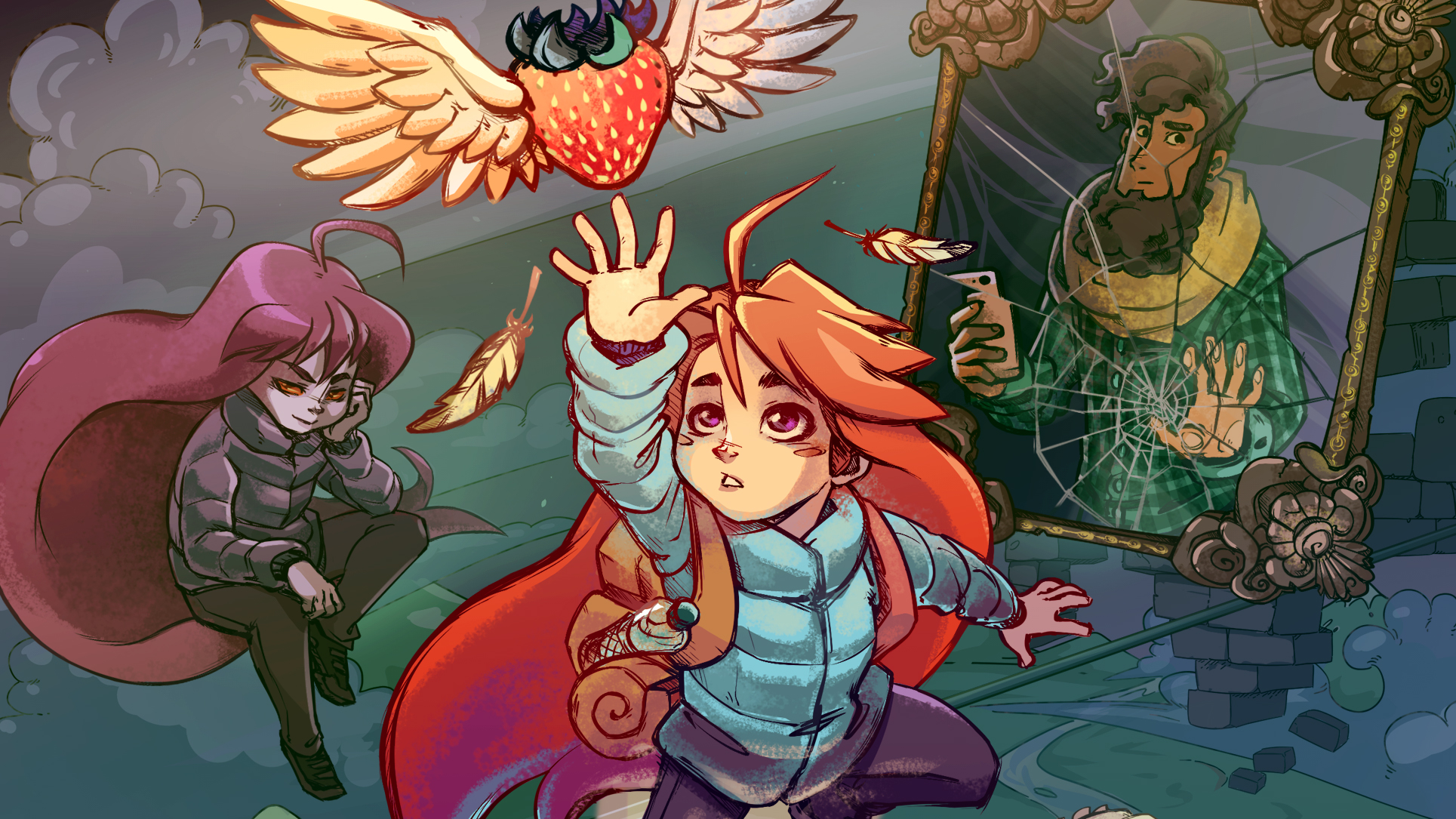
About halfway through Celeste, the game stops being a platformer about climbing a mountain and reveals what it has been about the whole time. Madeline — the protagonist, red-haired, anxious, determined — finds herself confronted by a dark reflection of herself. This reflection knows all her worst thoughts about herself. It speaks them aloud. It wears her face.
The game calls this entity Part of Me. It is not a villain. It is not something you defeat in a boss fight and leave behind. It is, quite specifically, the part of Madeline that believes she cannot do this, should not try, is not enough, will fail. And the game's central question — the one it builds to across eight chapters — is what you do with that part.
The answer it arrives at is one that clinical psychology has been arguing for decades, with increasing evidence: you bring it with you.
The Game
Celeste was developed by Maddy Thorson and Noel Berry and released in 2018. It is a precision platformer — the kind of game where you die frequently, respawn immediately, and die again. There are no loading screens between deaths; the loop is tight enough that a skilled player will die hundreds of times in an hour and not find it frustrating. The deaths are information. The mountain is genuinely hard.
Maddy Thorson confirmed after the game's release that Celeste was written while working through their own mental health and gender identity, and that Madeline's journey was in significant ways autobiographical. This matters for understanding the game's specificity: the anxiety depicted is not a general metaphor but a particular, lived texture — the kind that manifests as a voice in your head that knows all your weaknesses because it is built from them.
The game's B-sides and C-sides — optional harder versions of each chapter — extend the difficulty to something that borders on inhuman. They are not required to finish the game, and the game is explicit about this: an accessibility menu allows players to slow the game, add extra dashes, or turn on invincibility without shame or penalty. The game wants you to get to the top. It does not particularly care how.
Anxiety — The Research
Anxiety is not, clinically, the presence of fear. It is the persistent activation of the threat-detection system in the absence of immediate threat — or in response to threats that are real but not physically immediate, like social judgment, future failure, or the gap between who you are and who you believe you should be.
The cognitive model of anxiety, developed by Aaron Beck and Albert Ellis in the 1960s and 1970s and refined extensively since, identifies the core mechanism as automatic negative thoughts — rapid, habitual interpretations of events that skew toward threat. You submit work and immediately think it wasn't good enough. You enter a room and assume people are judging you. You attempt a hard thing and the voice says you're going to fail.
The traditional therapeutic response to automatic negative thoughts is challenge and reframing: identify the thought, examine the evidence for and against it, replace it with something more accurate. This works. It is also exhausting, because the thoughts are fast and the challenge is slow, and because arguing with your own anxiety tends to amplify engagement with it rather than reducing it.
Kristin Neff, a researcher at the University of Texas, began arguing in the early 2000s for a different approach. Her concept of self-compassion has three components: self-kindness (treating yourself with warmth rather than judgment when you suffer or fail), common humanity (recognising that struggle is a shared human experience rather than evidence of personal deficiency), and mindfulness (holding difficult feelings in awareness without over-identifying with them or suppressing them).
The research on self-compassion outcomes is robust and somewhat counterintuitive to people raised on the idea that high standards require self-criticism. Neff and colleagues found that higher self-compassion is associated with lower anxiety and depression, greater emotional resilience, higher motivation, and — this is the one that surprises people most — higher achievement. People who treat themselves kindly after failure try again faster, persist longer, and learn more effectively than those who respond to failure with self-criticism. The internal critic is not, it turns out, a performance enhancer.
Part of Me
The encounter with Part of Me in Celeste's sixth chapter is one of the most formally precise depictions of anxiety in any medium. Part of Me does not attack Madeline in the way a video game enemy attacks a player character. It mirrors her. It appears when she stops moving. It chases her only when she runs. It speaks in her voice with her words — the specific, personal litany of reasons this was always going to fail.
Madeline's initial response is suppression: if she can just keep moving, keep climbing, not look at it, it will go away. It doesn't. The suppression research here is extensive and not encouraging. Daniel Wegner's famous white bear experiments demonstrated that instructing people not to think of a white bear reliably increases thoughts of white bears — the act of monitoring for the unwanted thought activates it. Applied to anxiety: trying not to feel anxious tends to produce more anxiety, not less, because the monitoring required to avoid it is itself activating.
What the game eventually proposes, through the character of Theo and through Madeline's own gradual realisation, is integration rather than suppression. Part of Me is not a mistake. It is not something external that attached to her. It is a part of her that is frightened and needs something different than to be fought. In Chapter 7, she returns to the part of the mountain where she fell, finds Part of Me, and talks to it — not to argue with it, not to defeat it, but to listen to what it is actually frightened of. Then she brings it with her.
The merged Madeline, the one who summits the mountain, has two dashes instead of one. The anxiety did not have to disappear for her to succeed. It became a resource.
What To Do With This
The practical implication of Neff's self-compassion framework is specific and actionable in a way that "be kinder to yourself" usually isn't. When you notice you are being self-critical, the practice is to ask: what would I say to a close friend who was in this situation? Most people find the answer is radically different from what they say to themselves. The friend would be acknowledged, encouraged, reminded that struggling is not the same as failing. The internal voice offers none of that.
The reason this works, Neff argues, is that self-criticism activates the threat system — the same system that anxiety runs on. Self-compassion activates the care system, which produces feelings of safety rather than danger. You cannot think clearly about how to climb when the threat system is engaged. You can when you feel safe enough to try.
Celeste puts this in platformer terms: Madeline dies hundreds of times. After each death she is back at the start of the screen in under a second, no commentary, no penalty, just the next attempt. The game refuses to make failure mean anything beyond information about what to try differently. This is not accident or mercy — it is the game modelling the relationship with failure that the story is arguing for.
The mountain is genuinely hard. The anxiety is real. Bringing both of those things along without using one to argue against attempting the other — that is the climb.
When you fail at something important to you, what does your inner voice usually sound like?
The takeaway: The internal critic is not a performance enhancer. Neff's research consistently finds that self-compassion produces better outcomes than self-criticism — more persistence, faster recovery from failure, and higher achievement. Celeste makes the same argument through a girl climbing a mountain with her own anxiety strapped to her back. The summit is reachable. You don't have to leave any part of yourself at the bottom to get there.
Play It on Whatever Settings You Need
Celeste's accessibility menu is worth discussing separately because it is, in itself, an argument about self-compassion. Most games hide assistance options or attach stigma to them — the implication being that the "real" experience requires difficulty. Celeste's assist mode is on the main menu, explicitly named, and accompanied by text that says using it does not diminish your experience. The developers mean this. The story is the same. The mountain is the same. The only thing that changes is how hard the platforming is.
If you play it with assists and reach the summit, you reached the summit. That is the part that mattered. The game already knew that before you started.
No comments yet — be the first!