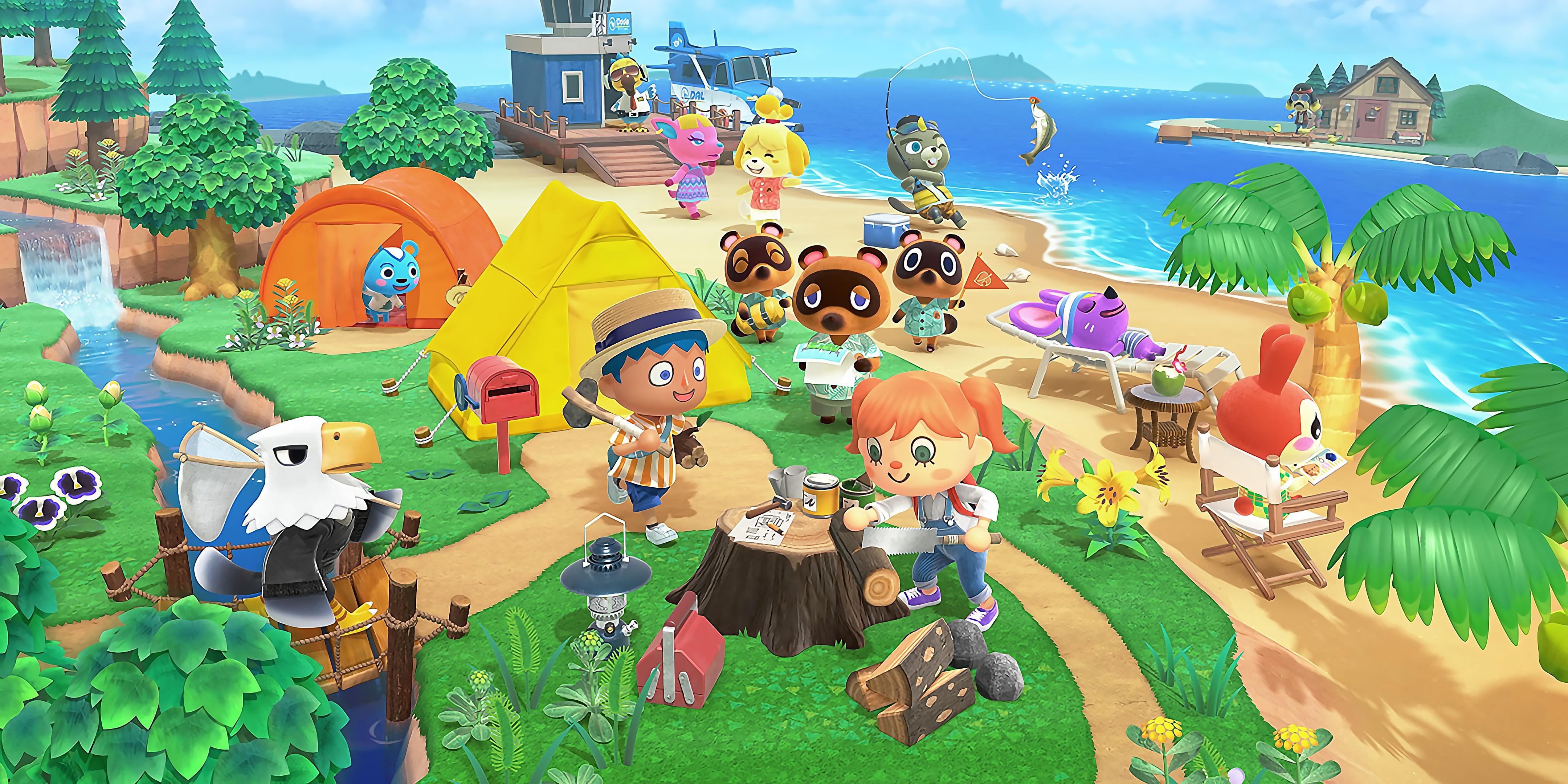
I spent approximately four months of my life working towards the Animal Crossing: New Horizons five-star island rating. I terraformed cliffs. I planted hybrid flowers in coordinated colour zones. I moved buildings two tiles to the left, then two tiles back, then three tiles to the right, then briefly considered whether I had made a terrible mistake somewhere around age twelve. I recruited the exact villagers I wanted through a process that involved visiting mystery islands at six in the morning before work, which is the kind of thing that sounds completely normal when you're in it and completely deranged in retrospect. And then, the day Isabelle announced that my island had achieved five stars, I put the Switch down and felt... fine. Pleased, briefly. And then vaguely flat in a way I couldn't quite explain.
I didn't log in the next day. Or the day after. My perfect island — the one I'd spent months building, the one I'd woken up early for — sat there in the cartridge, complete and unvisited. The villagers wandered around talking to each other. Tom Nook presumably remained enthusiastic about mortgage repayment. And I was elsewhere, unable to identify exactly what I was looking for that the finished island wasn't providing.
It took me an embarrassingly long time to recognise what had happened. The game hadn't changed. I had adapted. And the research on exactly this phenomenon turns out to be both illuminating and, depending on your disposition, either reassuring or mildly devastating.
The Game
Animal Crossing: New Horizons was released by Nintendo in March 2020 — which, timing-wise, was either perfect or extremely on the nose depending on how you look at it. Players arrive on a deserted island, are handed a tent and an enormous amount of debt by a racoon, and proceed to build a community from nothing: planting trees, catching fish and bugs, donating specimens to a museum, attracting new villagers, customising every inch of terrain and furniture. It is, in essence, a game about the long process of creating something you can feel proud of. The progression loop is genuinely satisfying — every day brings new things to do, new items to find, new seasonal events — and during its launch window it sold over a million copies in the first three days in Japan alone. In the UK it was the fastest-selling Nintendo title ever. People were not subtle about their fondness for it.
The design detail that connects directly to the psychology is the pacing. Animal Crossing runs in real time: seasons change, shops have opening hours, new items arrive on specific days. You cannot binge your way to completion the way you might in other games. Progress is deliberately slow, distributed across days and weeks and months. This is, it turns out, not just a design quirk. It's almost accidentally the best possible structure for sustained happiness — right up until the point where you run out of new things to discover.
The Happiness Set Point — The Research
In 2005, psychologists Sonja Lyubomirsky, Kennon Sheldon, and David Schkade published a paper titled "Pursuing Happiness: The Architecture of Sustainable Change" that has become one of the most cited in the field of positive psychology. Their central argument was a revision of an older model called the hedonic treadmill, first described by Brickman and Campbell in 1971. The treadmill metaphor captures the basic observation that people tend to return to a stable level of happiness — a set point — after both positive and negative life events. Lottery winners, the early studies showed, were not significantly happier than non-winners twelve months after their win. People who had experienced severe accidents were not as unhappy as you'd expect, twelve months later. The emotional response to life events fades; the baseline reasserts itself.
What Lyubomirsky and colleagues added was a framework for understanding what actually does produce sustained happiness rather than temporary spikes. Their model divides the factors influencing happiness into three categories: genetic set point (roughly 50% of the variance, relatively fixed), life circumstances (roughly 10% — which is startlingly low given how much effort most of us put into changing them), and intentional activity (roughly 40%). The critical insight about circumstances versus activity is that circumstances adapt to baseline quickly — a new house, a better job, a bigger salary become the new normal surprisingly fast. Intentional activities — things you actively do, especially things that are effortful, varied, and social — produce more durable happiness because they're harder to adapt to. Novelty keeps the response alive.
The specific mechanism is something Lyubomirsky calls the adaptation principle: emotional responses are driven more by change than by absolute level. The first bite of something delicious produces more pleasure than the fifth. The first month in a new flat feels different from the twelfth. The brain is a change-detector, not an absolute-level gauge, and it recalibrates constantly. This is useful for coping with hardship — we adapt to bad circumstances too — but it means that pursuing happiness through acquisition, through achieving stable states, is running the wrong race. The state, once achieved, becomes the new normal. The pursuit was the point all along.
The Island That Lost Its Magic
Animal Crossing: New Horizons is a nearly perfect case study in hedonic adaptation because it makes the process so legible. In the early weeks, everything is new: the first time you catch a rare bug, the first time a coveted villager moves in, the first time you successfully grow a gold rose. The emotional payoff of each of these events is real and genuine. But the more complete the island becomes, the fewer first-times remain. The museum fills up. The resident services building reaches its final form. The last furniture item you needed is finally in Nook Shopping. And then you have everything — which is structurally the same as having nothing new to discover, and your brain, faithful to its change-detecting architecture, has very little to work with.
The social comparison dimension makes this worse, or at least more vivid. During the 2020 peak, visiting a friend's island and seeing a design choice you hadn't thought of would immediately reactivate the desire to improve your own. This is the comparison mechanism that psychologist Leon Festinger described in his 1954 social comparison theory: we evaluate our own situations primarily in relation to others, not in absolute terms. The moment someone else's island showed you something new, your own felt incomplete again, and the motivation flooded back. Which is not exactly a healthy basis for ongoing engagement, but it is extremely effective at keeping you logging in.
The Treadmill Is Not a Trap
Here is the part that Lyubomirsky's work makes clear, and that Animal Crossing almost teaches by accident: the treadmill isn't something you escape. You work with it. The research finding that intentional activities outperform circumstances at producing sustained happiness isn't a condemnation of wanting things — it's a signpost pointing towards process over destination. The happiness wasn't in having the five-star island. It was in the daily log-in to see what was new, in the slow accumulation of progress, in showing a friend what you'd built and watching them react. Those things were the activity. The completed island was the circumstance.
In practice, what this looks like is deliberately not finishing things all at once. The slow, real-time pacing that Nintendo built into Animal Crossing wasn't just restraint — it was, perhaps inadvertently, good psychology. You can't adapt to something that keeps changing. The players who remained happiest with the game the longest weren't the ones who optimised their islands as fast as possible. They were the ones who played it slowly, set new small goals, brought other people in, and treated it as something ongoing rather than something to be completed.
When you finally achieve something you've been working towards for a long time, how do you usually feel?
What To Do With This
Lyubomirsky's framework suggests two practical countermoves against hedonic adaptation. The first is variety — deliberately varying how you engage with something good, so that the brain's change-detection system keeps finding fresh input. The second is savourings: consciously slowing down to notice positive experiences while they're happening rather than racing through them towards the next milestone. Both of these are things you can do in Animal Crossing and in life, and both of them require actively resisting the pull towards completion that makes us rush through the process to get to the destination.
The other shift worth making is away from circumstance goals — getting the thing, reaching the level, achieving the state — and towards activity goals: doing the thing, engaging with the process, connecting with someone else through it. These are harder to adapt to, because they're inherently about change and engagement rather than stable possession. The island finished is a circumstance. The daily walk through it with something new to notice is an activity. One of those has a much longer shelf life, and Animal Crossing tells you exactly which one, if you pay attention to where the actual pleasure was coming from all along.
The takeaway: Sonja Lyubomirsky's research on hedonic adaptation shows that emotional responses are driven by change, not by absolute level — which is why achieving stable goals produces happiness that fades faster than the process of working towards them. Animal Crossing: New Horizons demonstrates this with remarkable precision: the joy was in the journey, the daily discoveries, the gradual accumulation. The finished island was just the evidence that the good part was over.
Play It Slowly, If You Play It At All
Animal Crossing: New Horizons is still, genuinely, one of the most pleasant games ever made. The ambient sound design alone is worth the price of entry. But if you're going to play it, play it the way it was designed to be played: a little at a time, with no rush to complete the museum or achieve the rating or unlock everything. The game is its best when it functions as a small daily ritual rather than a project to be finished. Visit a friend's island. Pick the season fruit. Talk to Blathers about a fossil. And if you catch yourself staying up until 2am time-travelling to accelerate your progress — pause, gently, and ask yourself what you're rushing towards and whether you've thought about what happens when you get there.
No comments yet — be the first!