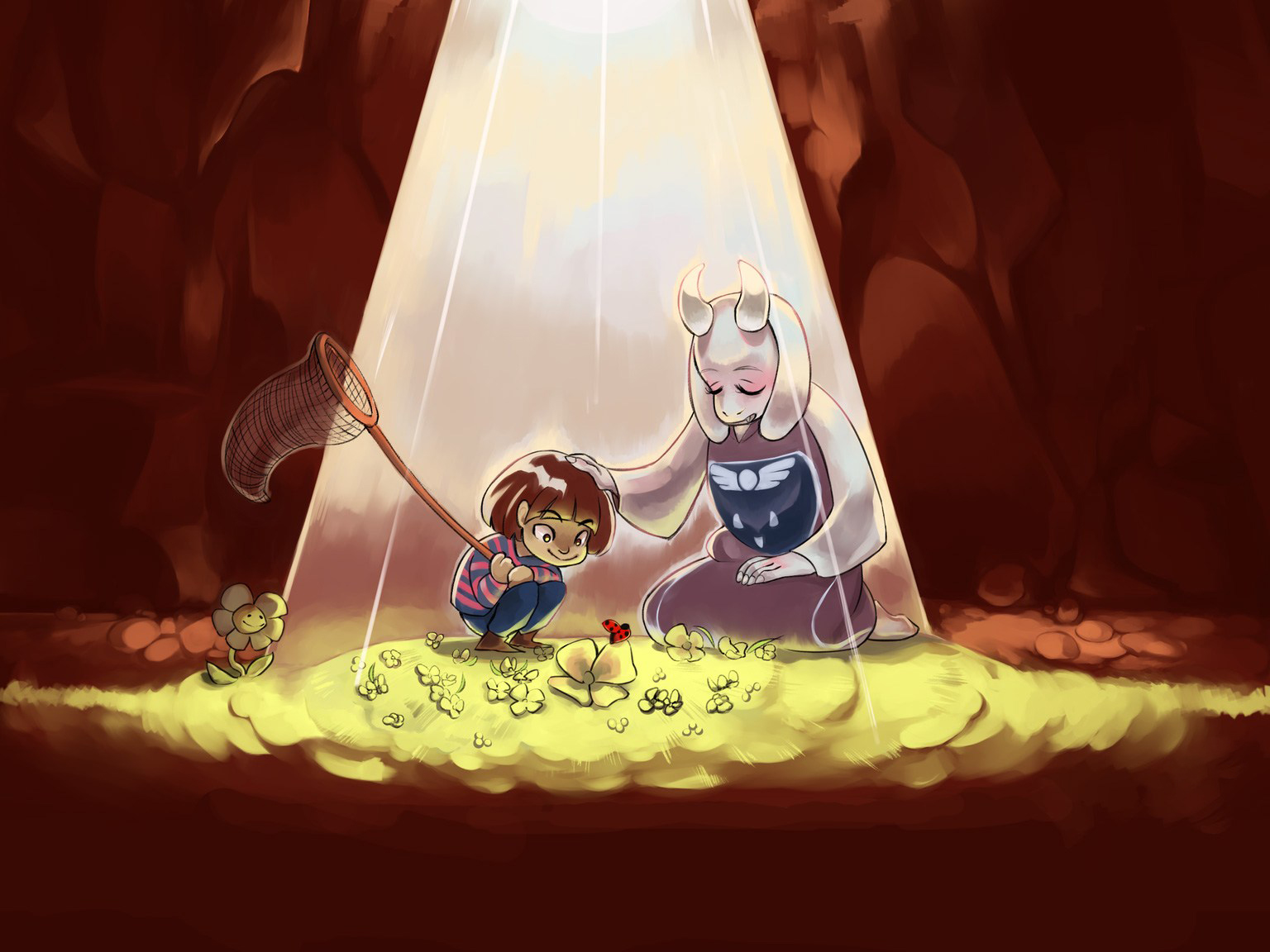
I am going to start with something I rarely admit on the internet: a game made me cry. Not welling up slightly, not a dignified single tear — genuinely, embarrassingly cry. In my living room, alone, at a game that looks like it was made in 1996 and contains a boss fight where you have to spare a skeleton's feelings rather than kill him.
The game is Undertale. Toby Fox made it almost entirely alone over three years and released it in 2015 for less than €10. It has sold over seven million copies. It has been discussed in academic papers about game design, ethics, and narrative. It is, by almost any reasonable metric, one of the most important games ever made.
And its central argument — the thing it is trying to tell you — is this: violence is always a choice, and choosing otherwise is harder, slower, and more interesting.
The Game That Asks What You Actually Want
You play as a child who falls into the Underground, a world beneath the surface where monsters live after being sealed there by humans long ago. The game can be completed without killing a single enemy. Every creature has a name, a personality, a reason they're fighting — and if you're patient, if you listen, there is always a way to resolve the encounter without anyone getting hurt.
This is not the default assumption of the RPG genre. The default assumption is that enemies exist to be defeated and defeating them is progress. Undertale makes that assumption visible by offering an alternative and watching what you do with it.
You can kill everything. The game allows it. It will even give you a technically functional ending. But it will not pretend you made a neutral choice.
The Empathy Research
Psychologists distinguish between two forms of empathy: cognitive empathy — understanding what someone else is experiencing — and affective empathy — actually feeling something in response to it. Research consistently shows that violent media does not inherently reduce empathy, but that the framing of the interaction matters enormously.
A 2014 study in Psychological Science (Greitemeyer & Mügge) conducted a meta-analysis of over 98 independent studies and found that prosocial video games — those involving cooperation, helping, or altruism — significantly increased empathic concern and decreased aggressive thoughts compared to violent games. Undertale is an almost clinical case study in prosocial game design: every encounter is framed as an opportunity to understand, rather than eliminate, the other party.
What makes this remarkable is the mechanical commitment. Most games that claim moral complexity give you a dialogue choice before or after combat. Undertale puts the empathy inside the combat itself. To spare an enemy you have to figure out what they need. Napstablook needs you to lie down and feel sad with them. Papyrus needs to be flattered in just the right way. Muffet needs you to wait long enough for a letter to arrive. The understanding is the mechanic, not the reward for it.
Has a game ever genuinely made you emotional — not just tense or excited, but actually moved?
Research note: Batson et al.'s foundational research on empathy-induced altruism (Journal of Personality and Social Psychology, 1991, replicated extensively since) showed that when people take the perspective of someone who is suffering, they are significantly more likely to help — even at personal cost. Undertale builds this as its core loop: understand the enemy's perspective, and the encounter resolves peacefully. It is, mechanically, an empathy training simulator.
What the Genocide Route Tells You
Here is where Undertale does something almost no game has attempted. If you choose to kill everything — every enemy, every named character, everyone — the game changes. Permanently. In ways the game warns you about before you do it. And when you reach the end of that route, the final boss tells you directly: you did not play this game. You satisfied an urge to destroy, and called it playing.
Then it offers you a deal. You can restore the world — but only by giving up something. The implication is that the save file that held the game's happiest ending is now gone. You have to decide if that's acceptable.
No other game I can think of has used its save system to make a point about moral accountability. It is, as design decisions go, extraordinary. And uncomfortable. And deliberately so.
The Part That Made Me Cry
There is a moment near the end of the Pacifist route — the ending where nobody dies — that I am not going to describe in detail because you should experience it yourself. What I will say is this: it earns it. Everything the game has asked you to do, every time it asked you to be patient and curious rather than efficient and destructive, pays off in that moment in a way that is genuinely moving.
The lesson, stripped down, is not complicated. It is: other people have inner lives as complex as yours, and treating them as if they do produces better outcomes for everyone involved — including you. Undertale is a €10 game that makes this argument more convincingly than most things I've read or watched or been told in my entire life.
Play it. Do the Pacifist route first. Cry when it asks you to.
No comments yet — be the first!